AI search is changing how people discover information online.
Instead of browsing through ten blue links, users increasingly receive direct answers from AI-powered search platforms such as ChatGPT, Perplexity AI, Google AI Mode, and Microsoft Copilot.
Many businesses focus immediately on content creation and AI SEO strategies. However, without the proper technical foundation, even excellent content may struggle to be discovered, understood, and cited by AI systems.
Before investing in advanced AI search optimisation, organisations need to ensure their websites are technically prepared for AI crawlers, retrieval systems, and large language models.
If you're new to the space, start with our AI search engine optimisation from the ground up guide, which explains how AI-powered search works and why technical readiness has become a critical ranking factor.
This guide explains the core setup requirements needed to improve AI search visibility in 2026.
Featured snippet
Why Technical Setup Matters for AI Search
Traditional SEO focused heavily on ranking pages.
AI search systems work differently.
Large language models often:
- Crawl and process websites
- Extract entities and facts
- Evaluate authority signals
- Retrieve content chunks
- Generate answers from multiple sources
- Cite trusted websites
If your website is difficult to crawl, slow to load, poorly structured, or missing key metadata, AI systems may struggle to understand and use your content.
Technical optimisation helps AI systems:
- Discover content faster
- Interpret content accurately
- Extract facts and entities
- Build confidence in your expertise
- Surface your information in AI-generated answers
Think of technical setup as the foundation that supports every AI SEO strategy.
Technical optimisation is only one piece of building your overall AI visibility strategy, which also includes entity development, content authority, citation acquisition, and brand recognition across AI platforms.
Core Technical Requirements for AI Search Optimisation
1. Ensure Full Crawlability
AI systems cannot use content they cannot access.
Start by reviewing:
Robots.txt
Avoid accidentally blocking:
- Important content sections
- Blog resources
- Knowledge hubs
- Product pages
- Documentation
Your robots.txt file should allow legitimate search crawlers access to public content.
XML Sitemaps
Maintain updated XML sitemaps that include:
- Articles
- Landing pages
- Product pages
- Resource pages
Submit sitemaps through:
Internal Linking
AI crawlers rely heavily on internal links to discover content.
Ensure:
- Key pages are accessible within a few clicks
- Related topics are connected
- Important resources receive internal links from authoritative pages
2. Use Clean URL Structures
AI retrieval systems prefer logical website architecture.
Good examples:
example.com/ai-search-optimisation-guide
example.com/ai-search-checklist
example.com/generative-engine-optimisation
Avoid:
example.com/page?id=3827
example.com/post-12345
Clean URLs help AI systems understand content topics quickly.
3. Build Topic-Based Site Architecture
AI search increasingly evaluates topical authority rather than isolated keywords.
Instead of creating random blog posts, organise content into topic clusters.
Example:
AI Search Optimisation Hub
Parent Page:
- AI Search Engine Optimisation Guide
Supporting Pages:
- AI Search Ranking Factors
- AI Search Content Optimisation
- AI Search Technical Requirements
- AI Search Measurement
- AI Search Case Studies
This structure helps AI systems understand relationships between topics.
Schema and Structured Data Requirements
Structured data helps machines understand content context.
While schema does not guarantee AI citations, it improves content interpretation.
Important schema types include:
Article Schema
Use on:
- Blog posts
- Guides
- Educational content
Helps AI identify:
- Author
- Publication date
- Topic
- Headline
FAQ Schema
Useful for:
- Question-based content
- Support articles
- Service pages
AI systems frequently reference FAQ-style content when generating answers.
Organization Schema
Helps establish:
- Business identity
- Brand information
- Contact details
- Social profiles
This improves entity recognition.
Person Schema
Particularly valuable when publishing expert content.
Include:
- Author credentials
- Experience
- Professional background
- Areas of expertise
Product and Service Schema
For commercial websites:
- Product information
- Pricing
- Reviews
- Services offered
Structured product data helps AI systems understand offerings more accurately.
Page Speed and Core Web Vitals
AI search platforms often favour content from websites that provide a strong user experience.
Slow websites create multiple problems:
- Poor crawl efficiency
- Reduced indexing rates
- Lower user engagement
- Higher bounce rates
Focus on:
Largest Contentful Paint (LCP)
Target:
Interaction to Next Paint (INP)
Target:
Cumulative Layout Shift (CLS)
Target:
Practical improvements include:
- Image optimisation
- CDN implementation
- Browser caching
- Minified CSS and JavaScript
- Efficient hosting infrastructure
Technical performance remains a strong trust signal.
Content Freshness Signals
AI systems frequently favour current and updated information.
Implement processes for:
Updating Existing Content
Refresh:
- Statistics
- Screenshots
- Examples
- Industry references
Update timestamps where appropriate.
Publishing Consistently
Regular publication demonstrates:
- Active expertise
- Ongoing authority
- Subject matter leadership
Maintaining Historical Content
Do not simply create new content.
Improve existing pages by:
- Expanding coverage
- Updating facts
- Adding new sections
- Improving citations
Freshness often contributes to AI retrieval confidence.
Entity Optimisation Foundations
AI systems increasingly rely on entity recognition.
An entity can be:
- A person
- A company
- A product
- A location
- A concept
Your website should clearly define:
Company Information
Include:
- Company name
- About page
- Contact information
- Team details
Expert Authors
Show:
- Credentials
- Industry experience
- Expertise areas
Consistent Brand References
Use consistent naming across:
- Website
- Social profiles
- Business directories
- Press mentions
The easier it is for AI systems to identify your entity, the easier it becomes to earn citations.
Data Feeds and API Considerations
As AI retrieval becomes more sophisticated, machine-readable data becomes increasingly important.
Consider:
Structured Databases
Product catalogues, directories, and resources should use:
- Consistent formatting
- Structured fields
- Standardised naming
Public APIs
Where appropriate, expose data through APIs.
Examples include:
- Product information
- Pricing data
- Knowledge databases
- Research datasets
AI systems can often interpret structured datasets more effectively than unstructured pages.
Knowledge Base Architecture
Create searchable knowledge repositories that include:
- FAQs
- Definitions
- Tutorials
- Research content
These resources frequently become AI citation sources.
Content Accessibility Requirements
AI systems process content similarly to how accessibility tools interpret websites.
Best practices include:
- Proper heading hierarchy (H1–H6)
- Descriptive image alt text
- Semantic HTML
- Readable content structure
- Mobile responsiveness
Clear structure benefits both users and AI systems.
Security and Trust Signals
Trust remains critical for AI visibility.
Ensure:
HTTPS Everywhere
Secure websites are now a baseline requirement.
Author Transparency
Display:
- Author names
- Credentials
- Publication dates
- Editorial standards
Contact Information
Include:
- Physical location
- Email address
- Contact page
Trustworthy websites are more likely to become reliable AI sources.
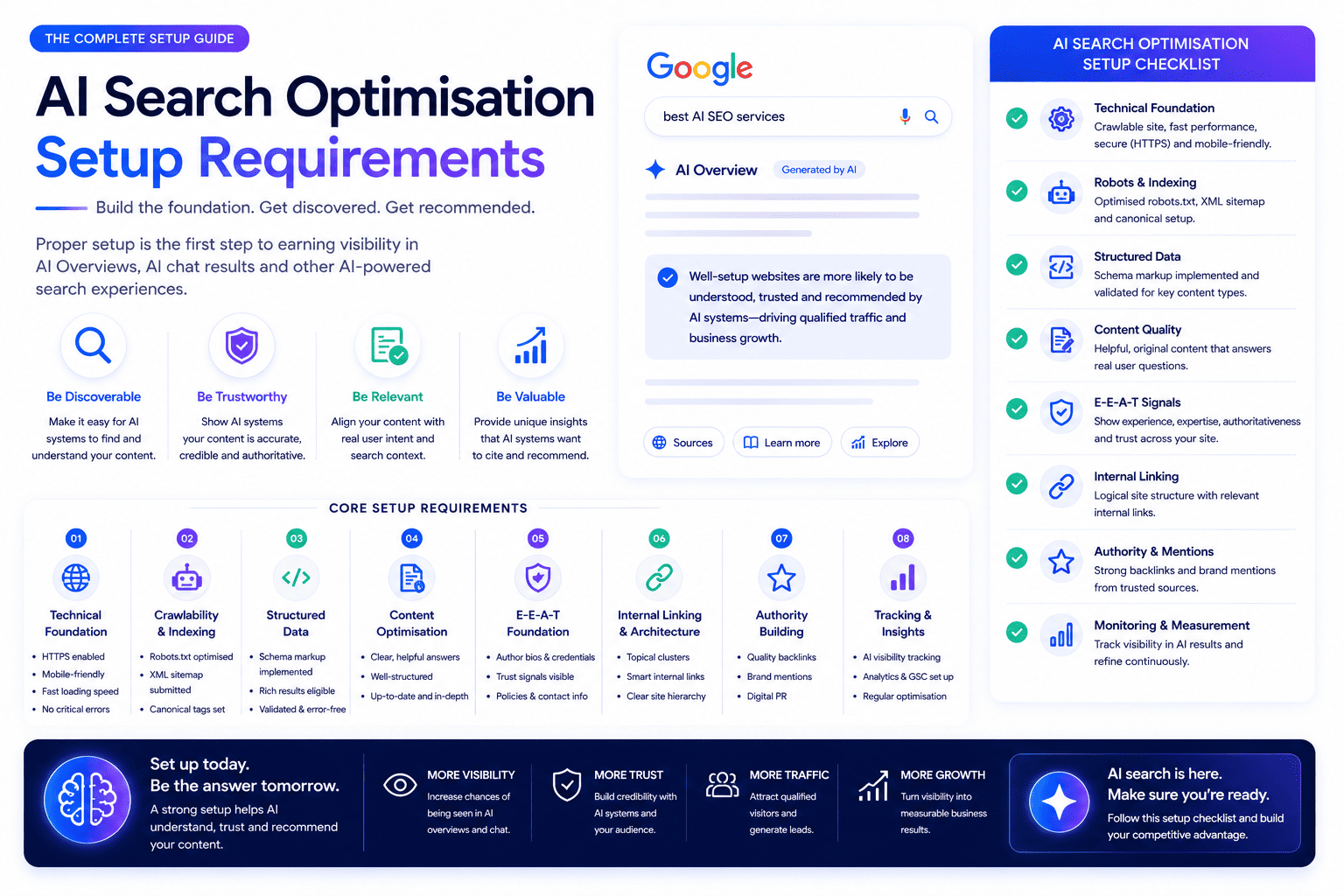
AI Search Optimisation Setup Checklist
Before pursuing advanced AI SEO strategies, confirm you have:
✅ Crawlable website architecture
✅ Updated XML sitemap
✅ Proper robots.txt configuration
✅ Fast-loading pages
✅ Strong Core Web Vitals
✅ Logical internal linking
✅ Topic cluster structure
✅ Article schema
✅ FAQ schema
✅ Organisation schema
✅ Author information
✅ HTTPS security
✅ Mobile responsiveness
✅ Content update process
✅ Consistent entity signals
✅ Accessible content structure
Common Technical Mistakes
Many websites struggle with AI visibility because they:
- Block crawlers unintentionally
- Publish thin content
- Lack structured data
- Have weak internal linking
- Load slowly
- Use inconsistent brand information
- Ignore content maintenance
- Fail to establish clear expertise signals
Fixing these issues often delivers faster results than publishing more content.
Frequently Asked Questions
What are the technical setup requirements for AI search optimisation?
Key requirements include crawlable site architecture, XML sitemaps, structured data, fast page speed, strong internal linking, content freshness, HTTPS security, and clear entity signals.
Does schema markup improve AI search visibility?
Schema helps AI systems understand content context and entities more effectively. While it does not guarantee citations, it improves machine readability and content interpretation.
How important is page speed for AI search?
Page speed remains important because faster websites are easier to crawl, provide better user experiences, and often demonstrate stronger technical quality signals.
Can AI search engines access content hidden behind JavaScript?
Some AI crawlers can render JavaScript, but relying entirely on client-side rendering may reduce discoverability. Server-side rendering and accessible HTML content are generally safer approaches.
Should I create APIs for AI search optimisation?
Not every website needs APIs, but structured, machine-readable data can improve accessibility and future-proof your content for evolving AI retrieval systems.
Conclusion
AI search optimisation begins with technical readiness.
Before focusing on advanced strategies, ensure your website can be easily crawled, understood, and trusted by AI systems. Strong site architecture, structured data, performance optimisation, entity clarity, and content freshness form the foundation of long-term AI visibility.
Businesses that establish these fundamentals today will be better positioned to earn citations, appear in AI-generated answers, and maintain visibility as AI search continues to evolve.
Ready to Improve Your AI Search Visibility?
A comprehensive technical audit can identify the issues preventing AI systems from discovering, understanding, and citing your content. Start with the foundation, then build advanced AI search optimisation strategies on top of it.


.png)

.png)