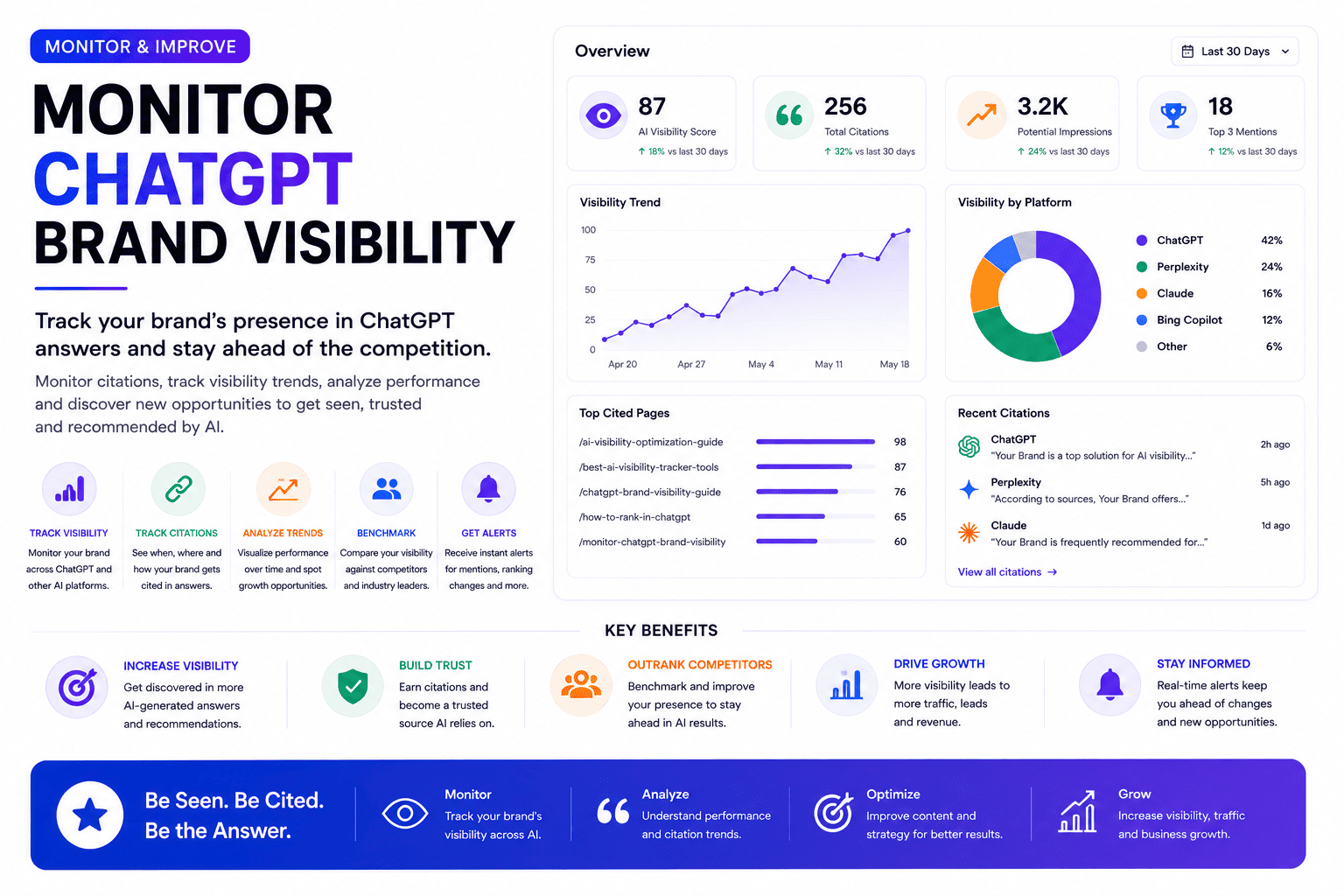
Quick answer: You can track brand visibility in ChatGPT two ways - for free, by running a set of real buyer prompts in an incognito ChatGPT window and logging whether your brand is mentioned, cited, or recommended; or with a dedicated tool (Peec AI, Profound, Otterly.ai, Semrush AI Toolkit, and others) that automates prompt testing, competitor benchmarking, and sentiment tracking across ChatGPT, Perplexity, Gemini, and Google AI Overviews. Most teams start manual and move to a tool once they need weekly, at-scale reporting.
Below is the full breakdown: what to measure, how to check it manually, which tools are worth paying for, and how to turn the data into a repeatable monthly report.
Why brand visibility in ChatGPT matters now
Search behavior has genuinely shifted. Zero-click search - where a user gets their answer and never visits a website - has gone from roughly 56% of Google searches in 2024 to about 69% a year after AI Overviews launched. ChatGPT itself is now handling roughly 2.5 billion prompts a day, and by early 2026 it had reached about 900 million weekly active users, according to OpenAI.
The behavior change that matters most for brand visibility: on most category and comparison prompts, around 93% of ChatGPT sessions end without a click to any website. If your brand isn't named in that answer, there's no "page two" to climb to and no click to win back later - the moment is over. That's the core reason "how do I see brand visibility in ChatGPT" and "how to track brand mentions in ChatGPT" have become such common searches: teams that were used to ranking pages now have no visibility into a channel that's actively shaping buyer decisions.
The upside is that this is measurable. The rest of this guide covers the metrics, the free method, and the tools people actually use in 2026.
What "tracking brand visibility in ChatGPT" actually means
Two things people often lump together are actually different, and the difference changes your strategy:
- Brand mentions - ChatGPT names your brand directly in its answer, usually pulled from what it learned during training or from live web sources it trusts.
- Citations - ChatGPT links out to a specific page as a source. You can be cited without being mentioned by name, and mentioned without a citation.
Fixing weak mentions is mostly a PR and earned-media problem - getting written about in the roundups, comparisons, and review sites that feed what the model has learned about your category. Fixing weak citations is closer to traditional SEO: keeping pages crawlable, current, and structured so the model can pull from them directly.
The metrics worth tracking
| Metric |
What it tells you |
| Mention Frequency |
How often your brand appears across a fixed set of relevant prompts (e.g., mentioned in 30 of 50 prompts = 60%). |
| Share of Voice (SOV) |
Your mentions as a percentage of total mentions across your brand and named competitors. |
| Average Position |
Where your brand appears when ChatGPT lists multiple brands. Being mentioned first generally carries more visibility and influence. |
| Sentiment |
Whether your brand is mentioned in a positive, neutral, or negative context. |
| Citation Sources |
The websites and sources AI models reference when discussing your category, helping identify PR and content opportunities. |
| Topic-Level Visibility |
Shows which topics, services, or use cases your brand is visible for and where you have gaps compared to competitors. |
One data point worth keeping in mind while you build your tracking: a Princeton and Georgia Tech study on generative engine optimization found that adding authoritative citations to web content increased the chance of that content being pulled into an LLM answer by 30 - 40%. Raw mention counts don't capture that distinction - a tool or process that only counts name-drops will miss the difference between a passing mention and a citation-backed recommendation.
How to check brand visibility in ChatGPT for free
This is the manual method, and it costs nothing but time. It's the right starting point even if you plan to add a paid tool later, because it tells you which prompts actually matter before you start paying to track hundreds of them automatically.
Step 1 - Build a prompt list. Write 15 - 50 prompts your actual buyers would type, pulled from real language: Search Console queries (like the ones you're already collecting), support tickets, Reddit threads, and Google's "People also ask." Mix three types:
- Branded: "What is [your brand]?"
- Category: "What are the best [your category] tools in 2026?"
- Use-case: "How do I [solve the problem your product solves]?"
Step 2 - Test in a clean session. Open ChatGPT in an incognito or logged-out window. ChatGPT personalizes answers based on your account's memory and chat history, so testing while logged in can quietly bias results toward your own brand.
Step 3 - Log the result for each prompt. For every prompt, record: mentioned or not, position in the list, sentiment, and any source ChatGPT cites. A simple spreadsheet works fine.
Step 4 - Repeat on a schedule. ChatGPT doesn't return the same answer twice, even for an identical prompt, so a single check is a snapshot, not a trend. Re-run the same prompt list weekly or monthly and compare over time.
Step 5 - Extend to other engines. Visibility varies a lot by platform, so it's worth running the same prompt list through Perplexity, Gemini, Claude, and Google AI Overviews rather than treating ChatGPT as the whole picture.
This manual approach is genuinely free, but it doesn't scale well past a handful of prompts checked occasionally - which is why most teams that search for "free tools for monitoring brand visibility in ChatGPT" eventually move to a dedicated platform once they need consistent, larger-scale tracking.
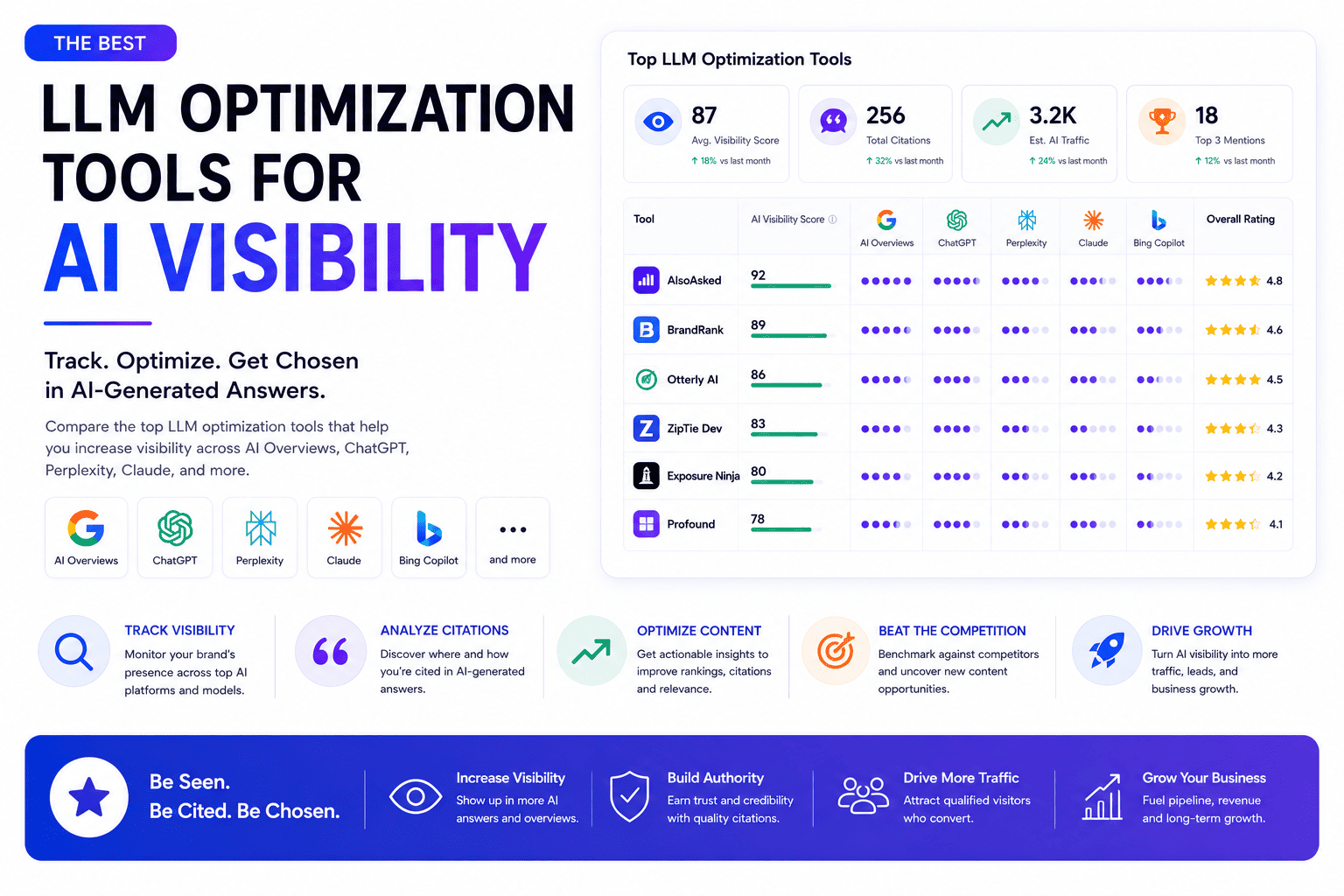
Best tools to track brand visibility in ChatGPT
Once manual checks become too time-consuming, these are the platforms most commonly used in 2026, based on current comparisons and vendor documentation. Pricing and coverage change often, so confirm current plans directly with each vendor before buying.
| Tool |
Best For |
Notes |
| Peec AI |
Agencies and mid-market teams wanting a fast, prompt-level ChatGPT visibility snapshot. |
Tracks ChatGPT, Perplexity, and Google AI Overviews on all paid plans, with other AI engines available as add-ons. Entry pricing starts at approximately €89/month. |
| Profound |
Enterprise teams needing deep share-of-voice reporting and governance. |
Custom, enterprise-focused pricing starting around $99/month. Offers advanced competitive benchmarking and governance features. |
| Semrush AI Toolkit |
Teams already using the Semrush ecosystem. |
Adds AI mention tracking and prompt visibility monitoring to an existing SEO workflow. |
| Otterly.ai |
Small businesses and solo marketers looking for an affordable entry point. |
A lightweight, budget-friendly platform designed for simple, ongoing AI visibility tracking. |
| Brand24 |
PR and brand teams focused on real-time monitoring. |
Detects AI-influenced brand mentions and alerts users to share-of-voice changes as they occur. |
| SE Ranking |
Teams wanting AI visibility integrated into a broader SEO platform. |
Monitors mentions and rankings across ChatGPT, Google AI Overviews, and AI Mode with historical performance comparisons. |
If Google AI Overviews specifically is a bigger priority for you than ChatGPT, it's worth pairing this list with dedicated AI Overview SEO rank tracking methods - the tooling and signals overlap, but AI Overviews pulls from a different mix of sources than ChatGPT does. | ZipTie | Teams tracking ChatGPT, AI Overviews, and Perplexity specifically | Does not currently cover Gemini or Copilot - check fit if those matter to your audience | | Scrunch AI | Brands worried about outdated or inaccurate AI descriptions | Focuses on narrative accuracy - flags stale pricing, features, or positioning that AI tools repeat |
A rough way to choose: if you just need to know whether you're showing up, a focused tracker like Peec AI or Otterly.ai is enough. If you need enterprise-grade competitive benchmarking and reporting for leadership, Profound or Semrush AI Toolkit fit better. If your biggest risk is AI describing your brand incorrectly rather than not mentioning it at all, prioritize a tool with accuracy/hallucination detection built in.
Setting up alerts and a monitoring cadence
Monitoring only pays off if it triggers action. Set alerts for:
- Visibility drops - mentions or Share of Voice decline over consecutive checks
- New competitors appearing - a brand you weren't tracking starts showing up regularly
- Sentiment shifts - a previously neutral or positive mention turns negative
- New source citations - ChatGPT starts pulling from a publication you haven't engaged with yet
On cadence: weekly checks suit fast-moving, competitive categories; monthly is enough for most other brands. A useful priority order if you're limited on time is ChatGPT and Google AI Overviews first (largest combined reach), then Perplexity, then a quarterly pass on Gemini and Claude - those two currently see smaller volume for most categories but skew toward technical and professional users, so weight them higher if that's your buyer.
Benchmarking against competitors
Tracking your own brand in isolation only tells half the story. Build a simple competitor list and track the same metrics - mention frequency, Share of Voice, average position, topic ownership, and sentiment - for each one. This is where most of the paid tools above earn their cost: manually running the same prompt set for three or four competitors every week gets tedious fast, and automated benchmarking is usually the first thing teams pay for once they outgrow the free method.
A simple monthly reporting template
Keep the report short enough that someone outside marketing can read it in two minutes:
- Executive summary: overall visibility score, Share of Voice, and the trend direction
- Brand performance table: mentions, SOV, and average position - this month vs. last month
- Wins: new topics or prompts where you started appearing, new citation sources earned
- Gaps: topics or prompt categories where you're consistently absent, and which competitors are filling that space
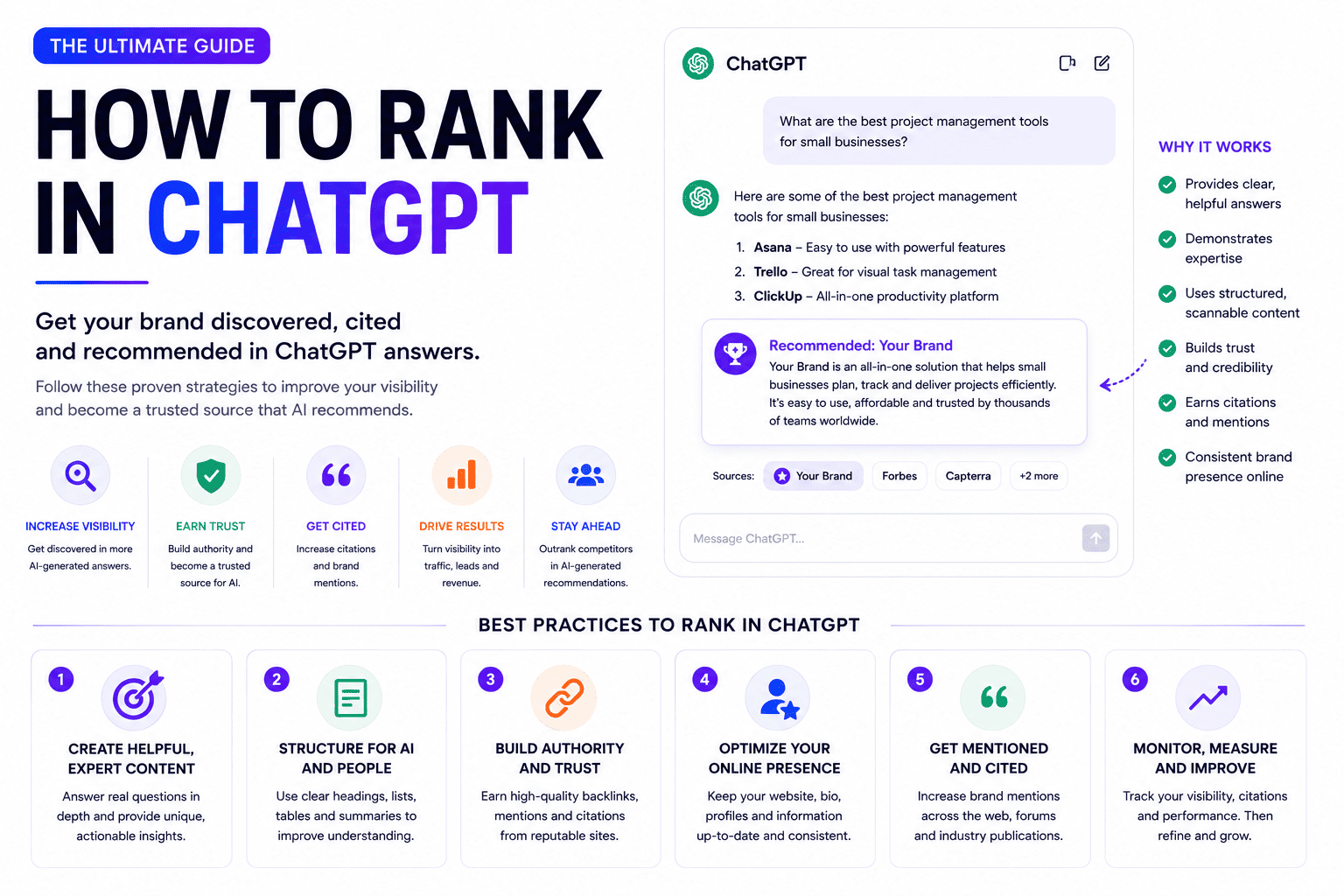
How to actually improve visibility, not just monitor it
Monitoring shows you the gap - closing it is a separate project. For the full playbook on how to grow your brand's ChatGPT visibility, here are the levers that matter most:
- Publish content the model can cite - in-depth, well-structured pages that answer specific buyer questions tend to get pulled into answers more than thin marketing copy.
- Earn third-party coverage. Most AI citations don't come from a brand's own site - one recent GEO study found roughly 83% of AI citations trace back to external sources like reviews, news, and analyst reports, versus about 17% from brand-owned pages. Digital PR and earned media matter more here than in traditional SEO.
- Keep entity information consistent - your name, description, and category should match across your site, social profiles, and directories so models don't have conflicting signals to reconcile.
- Refresh content regularly - stale pages are less likely to be pulled into current answers.
- Watch what competitors that consistently appear are doing - which sources cite them, how their content is structured, and where their authority signals come from.


.png)

.png)