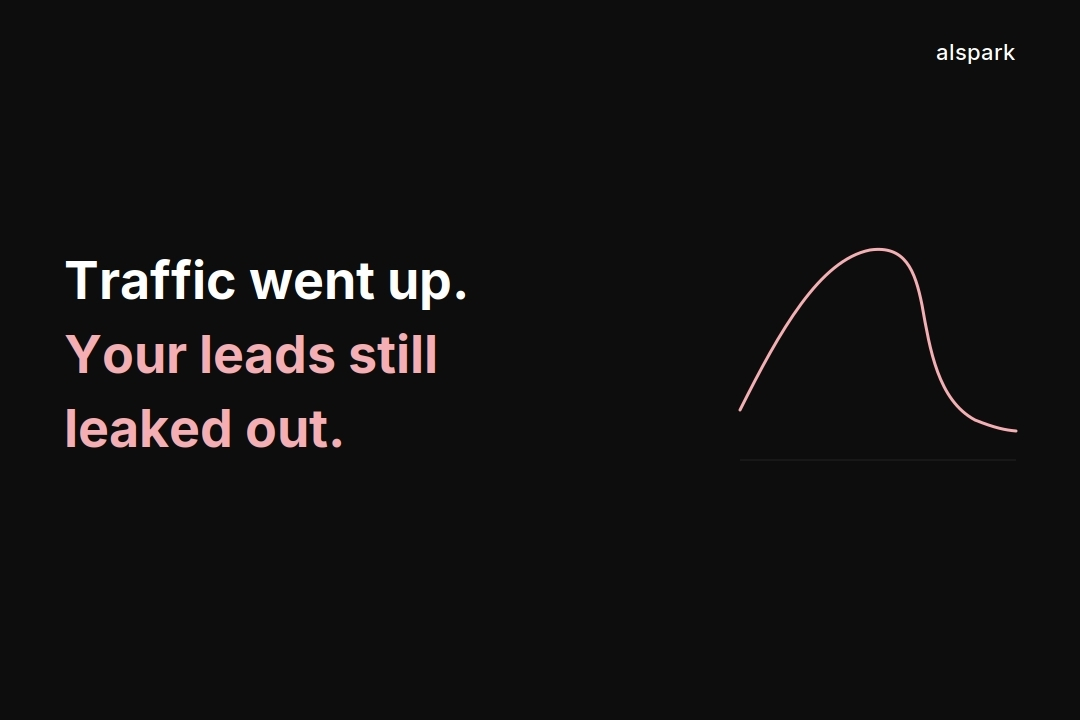
There’s a frustrating paradox in B2B marketing: you invest in SEO, paid ads, and content marketing, traffic increases, but your pipeline doesn’t grow at the same pace. You generate leads, but many never become customers. The problem isn’t volume, it’s conversion discipline.
HubSpot research indicates that improving lead-to-customer conversion rates is a key priority for many marketing teams. Yet many businesses still focus heavily on driving traffic without addressing what happens after the click.
If your leads aren’t converting, it usually comes down to a few common breakdown points in your funnel. This guide outlines five of the most common conversion leaks and how to fix them using insights from McKinsey & Company and Harvard Business Review.
You’re attracting visitors who aren’t a good fit for your solution. They may be interested, but they lack budget, authority, or a clear need. This often happens when you optimise for traffic volume instead of qualified traffic.
When targeting is too broad or messaging is too generic, you attract leads that never progress. These leads may engage initially but fail to convert into real opportunities.
B2B Example: A RevOps platform targets “sales managers” with messaging around “pipeline visibility.” The campaign attracts a wide audience, including individuals who are not decision-makers or do not have purchasing authority.
Shift from volume-based to intent-based targeting. Focus on high-fit accounts, use lead scoring to prioritise quality, and align messaging with specific problems your solution solves.
As McKinsey & Company notes, B2B buying has become increasingly digital and self-directed, with buyers expecting more personalised and relevant interactions throughout their journey.
Your landing pages and sales materials fail to clearly communicate value. Prospects struggle to understand how your solution helps them achieve meaningful business outcomes.
When messaging focuses on features instead of outcomes, prospects lose interest. If they can’t quickly see the impact on their business, they disengage.
B2B Example: A cybersecurity vendor highlights technical features like encryption and compliance but does not clearly explain how those features reduce risk or improve business performance.
Reframe messaging around outcomes. Clearly connect your solution to measurable improvements such as efficiency, revenue growth, or risk reduction. Focus on the problem, the impact, and the result.
Modern B2B buyers tend to focus on outcomes and measurable impact when evaluating solutions.
Leads go cold because follow-up is delayed, inconsistent, or generic. When initial interest isn’t acted on quickly, engagement drops.
Without a structured follow-up process, leads lose momentum. By the time outreach happens, the prospect may already be evaluating other options or has lost interest.
B2B Example: A SaaS company receives demo requests but delays responses due to limited sales capacity. As a result, potential buyers move forward with competitors.
Establish a clear and consistent follow-up process. Ensure timely responses, personalise communication, and create a structured system for handling inbound leads.
As Harvard Business Review highlights, B2B lead generation has evolved from informal, relationship-driven approaches to more structured and data-driven processes, making coordinated and timely follow-up essential.
Marketing and sales operate with different definitions of a qualified lead. This creates friction during handoff and slows down the conversion process.
Sales teams spend time on low-quality leads, while high-potential opportunities are not prioritised effectively. This misalignment creates inefficiencies that impact conversion.
B2B Example: Marketing defines a qualified lead based on content engagement, while sales expects clear buying intent. The disconnect leads to confusion and missed opportunities.
Define clear qualification criteria that both teams agree on. Establish a structured handoff process and ensure visibility into lead context and activity.
Strong alignment between marketing and sales teams improves conversion outcomes and pipeline efficiency.
Your website, landing pages, and conversion flows are treated as static. There is little testing or iteration based on performance data.
Without ongoing optimisation, you rely on assumptions rather than evidence. Small issues in messaging, layout, or flow can reduce conversion rates over time.
B2B Example: A company continues using the same landing page without testing different messaging or call-to-action placements, missing opportunities to improve performance.
Adopt a continuous optimisation mindset. Regularly test and refine key conversion points such as landing pages, forms, and messaging.
HubSpot highlights that advances in tools and data have made conversion rate optimisation more accessible and easier to implement.
Traffic without conversion is a missed opportunity. The five leaks outlined above are not isolated issues. They reflect a broader gap in how conversion is managed.
Conversion discipline means:
When you shift from a traffic-first mindset to a conversion-focused approach, you build a more efficient and predictable growth engine.
Traffic is increasing. Leads are coming in. But conversion isn’t following.
That’s not a traffic problem. It’s a funnel problem.
When conversion leaks go unaddressed, more traffic only amplifies inefficiencies. What looks like growth at the top of the funnel turns into missed revenue at the bottom.
The opportunity is not to generate more leads. It is to fix how they move through your funnel.
Ready to identify where your funnel is leaking?
Book a Growth Audit with alspark. We’ll evaluate each stage of your funnel, pinpoint where leads drop off, and give you a clear, prioritised plan to improve conversion performance.
It is almost always a funnel problem, not a traffic problem. One of the five leaks covered above is usually absorbing your extra visitors before they become paying customers:
● Wrong-audience targeting
● Weak value proposition
● Slow follow-up
● Sales and marketing misalignment
● Lack of testing
If you're getting tons of leads but conversion is terrible, the underlying cause is almost never a lack of demand.
There is no single benchmark that applies to every B2B company, since deal size, sales cycle length, and industry all shift the number. Instead of chasing an external benchmark, work out your own true lead-to-SQL conversion math and watch for the funnel stage where the steepest percentage of leads drops off. That stage is your priority leak.
Within the first hour, and ideally much sooner. Harvard Business Review's research found that firms contacting a new lead within an hour were nearly seven times more likely to qualify it than those that waited even one hour longer, so every hour of delay is a measurable drop in your odds.
Map your funnel stage by stage and calculate the percentage drop at each step:
● Traffic to lead
● Lead to MQL
● MQL to opportunity
● Opportunity to close
The stage with the sharpest drop is normally your primary leak, and it is usually where the fix pays off fastest.
It is both. Conversion leaks typically form at the handoff between marketing and sales, so fixing them requires shared lead definitions and joint ownership of the metric, not one team acting alone.
1. HubSpot. 2026 Marketing Statistics, Trends, & Data.
www.hubspot.com/marketing-statistics
2. McKinsey & Company. Future of B2B sales: The big reframe.
3. Harvard Business Review. The New Rules of B2B Lead Generation.
hbr.org/2021/06/the-new-rules-of-b2b-lead-generation
4. Harvard Business Review. The Short Life of Online Sales Leads.