In the high-stakes world of B2B growth, most leaders focus on the top of the funnel. They invest heavily in SEO, paid ads, and content marketing to drive traffic, assuming that more "eyes" will inevitably lead to more revenue. However, for many B2B firms, the problem isn't a lack of traffic, it's a leaky system.
According to research from McKinsey & Company, many companies overlook practical, high-impact growth actions, leaving significant gains on the table. Sustainable growth comes from identifying performance gaps and activating targeted levers such as improving pricing, reducing churn, and strengthening sales execution. In fact, high-growth companies invest more heavily in sales operations, reinforcing the importance of execution discipline.
Revenue leakage isn't just a marketing problem or a sales problem. It is a systemic failure. It occurs when potential revenue slips through the cracks during handovers, data gaps, or pricing inconsistencies. If you’re seeing high traffic but stagnant revenue, your growth system is likely leaking.
Many B2B businesses focus heavily on driving traffic, but revenue is determined by how effectively that demand is converted. When conversion rates from MQL (Marketing Qualified Lead) to SQL (Sales Qualified Lead) decline, additional traffic simply amplifies inefficiencies instead of driving growth.
Revenue leakage at this stage often stems from a lack of alignment on what constitutes a "qualified" lead. When marketing delivers volume without quality, sales teams become frustrated, follow-up slows down, and high-intent prospects drop off. This often creates a gap between initial interest and actual buying intent, where potential revenue can be lost before entering the sales pipeline.
One of the most critical points in any B2B growth system is the handover between marketing and sales. This is where breakdowns in communication, context, and ownership can result in lost opportunities.
To identify leaks here, audit your Lead-to-Opportunity conversion rate. If there’s a significant drop-off, look for:
Even small inefficiencies at this stage can compound into meaningful revenue loss over time.
Data gaps are silent revenue killers. When data is missing, inconsistent, or siloed, your revenue engine stalls.
According to Outreach.io, revenue leakage often occurs when qualified opportunities fail to convert due to internal execution issues such as delayed follow-ups, incomplete data, and inconsistent engagement. These are not competitive losses but preventable failures within the sales process.
Common data leaks include:
Even a small number of stalled or poorly managed deals can compound into meaningful missed revenue and unreliable forecasts.
Even when a deal reaches the final stage, revenue can still leak through pricing and contract inefficiencies.
Research from Harvard Business Review shows that poor pricing practices often go unnoticed while quietly eroding margins. Many B2B companies underprice deals due to misaligned sales incentives and lack of pricing discipline. In fact, a large majority of companies acknowledge that their pricing decisions could be improved, highlighting how widespread this issue is.
If your sales team is discounting to close deals without a clear framework, you are likely experiencing pricing leakage.
Delays in contract closure can also increase the risk of deals stalling or falling through, which impacts revenue realization.
Identifying revenue leakage is only half the battle. Fixing it requires a structured approach. Revenue Operations (RevOps) aligns marketing, sales, and customer success under a unified system of data, processes, and technology.
Rather than focusing only on generating demand, high-performing B2B organizations build systems that optimize every stage of the revenue lifecycle. This ensures opportunities are captured, progressed, and converted efficiently.
By implementing a RevOps framework, you can:
Revenue leakage is the silent enemy of B2B growth. It is not enough to generate demand. You must ensure that every opportunity is effectively converted into revenue.
In many cases, the companies that grow consistently are those that systematically identify and fix the gaps where revenue is lost.
If you suspect your growth system is leaking, it is time for a diagnostic audit. Identifying where your system is failing is the first step toward building a predictable, scalable revenue engine.
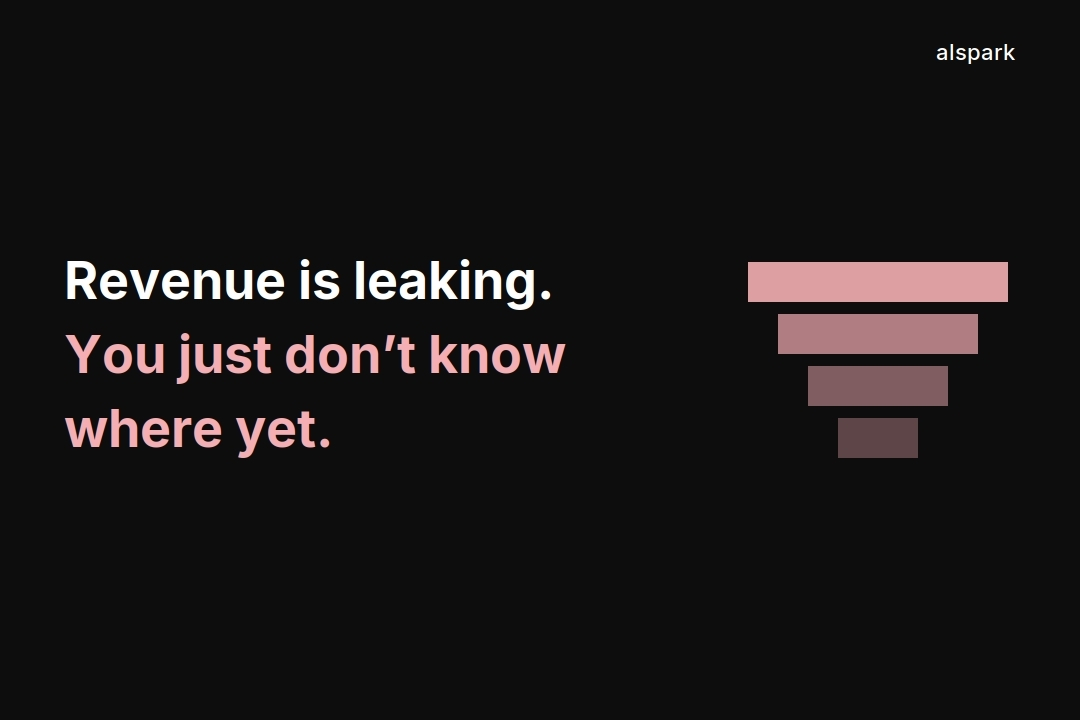
Revenue is not lost in one place. It leaks across your entire funnel.
Leads are being generated. Opportunities are entering the pipeline. Deals are progressing. But without visibility into how each stage performs, small breakdowns in follow-up, data, and pricing quietly compound into lost revenue.
The opportunity is not to increase activity. It is to fix the points where revenue is already slipping through.
Ready to see where your growth system is leaking?
Book a Growth Audit with alspark. We will map your funnel end-to-end, identify where opportunities stall or drop off, and give you a clear, actionable plan to improve conversion and capture more revenue from your existing pipeline.
The two terms describe different things:
● Revenue leakage: Revenue that was already earned or achievable, lost to a process failure, not to a lack of demand.
● Low conversion rate: A broader symptom that can share the same causes, but doesn't always mean an operational gap.
A high-traffic funnel with strong lead quality can still leak heavily if the handover between marketing and sales breaks down.
Two checks separate a leak from a demand problem:
● Volume vs. revenue trend: Flat or growing traffic with flat or declining revenue points downstream of demand generation.
● Stage-by-stage conversion: Check MQL to SQL, SQL to opportunity, and opportunity to close separately, not just the overall win rate.
Start with the marketing-to-sales handover, since it moves fastest and is easiest to measure:
● Audit Lead-to-Opportunity conversion: Check your current rate and how it has trended over the last two to three quarters.
● Check speed to first contact: Measure your average response time to a new lead in hours, not days.
● Work backward only if needed: Move into the CRM and pricing stages only if the handover numbers look healthy.
Yes, a first-pass audit doesn't require RevOps software:
● To get started: Just your existing CRM export and a spreadsheet, no platform required.
● When tooling helps: Once leaks are confirmed, RevOps tools help automate fixes like lead routing or follow-up reminders.
Run this audit on two different cadences:
● Twice a year: Run a full audit, since benchmarks and team structure shift enough in six months to open new gaps.
● Every quarter for a year: Recheck the last stage you fixed, since a closed leak is the one most likely to quietly reopen.
1. McKinsey & Company. Growth amid uncertainty: jump-starting B2B sales performance.
2. Gartner. The B2B buying journey.
www.gartner.com/en/sales/insights/b2b-buying-journey
3. Harvard Business Review. The short life of online sales leads.
www.hbr.org/2011/03/the-short-life-of-online-sales-leads
4. Outreach. Revenue action orchestration (citing KPMG research).
www.outreach.io/resources/blog/revenue-action-orchestration
5. HubSpot. Database decay simulation (based on MarketingSherpa research).
www.hubspot.com/database-decay
6. Harvard Business Review. A survey of 1,700 companies reveals common B2B pricing mistakes.
www.hbr.org/2018/06/a-survey-of-1700-companies-reveals-common-b2b-pricing-mistakes
7. Gartner. Gartner predicts 75% of the highest-growth companies will deploy a RevOps model.