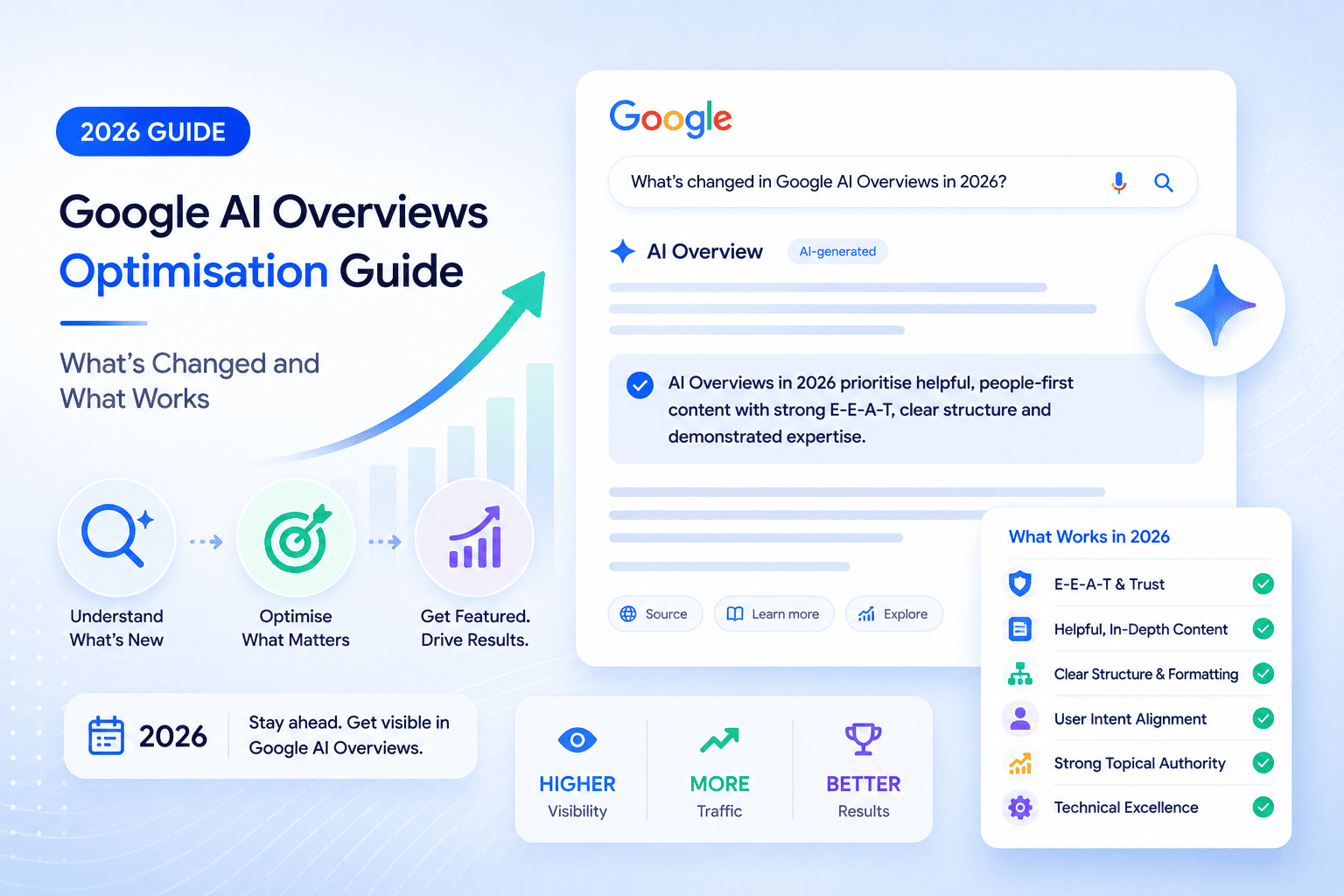
Search has changed dramatically over the last two years. Traditional rankings still matter, but being cited inside AI-generated answers has become just as important for visibility, traffic, and brand authority.
In 2026, Google AI Overviews are more sophisticated, more selective, and more heavily influenced by content quality signals than ever before. Businesses that understand how AI selects, evaluates, and references content are gaining a competitive advantage, while those relying solely on traditional SEO tactics are seeing diminishing returns.
This guide explains what has changed in AI Overviews, the ranking signals that matter most, and the optimisation strategies that are producing results in 2026.
Featured snippet
What is AI Overview optimisation?
AI Overview optimisation is the process of improving content so it can be selected and cited within AI-generated search summaries.
What Changed in AI Overviews in 2026
AI Overviews have evolved from simple answer summaries into highly contextual response systems that synthesize information from multiple sources.
Key changes include:
1. Stronger Emphasis on Demonstrated Expertise
Google is placing greater emphasis on content that demonstrates first-hand experience, expert insights, proprietary data, and original analysis.
Pages that simply rewrite existing information are less likely to be cited in AI-generated responses.
2. Entity-Based Understanding Has Expanded
AI systems now evaluate content based on topics, entities, relationships, and contextual relevance rather than relying primarily on keyword matching.
This means comprehensive topical coverage often outperforms keyword-focused content.
3. Multi-Source Citation Selection
AI Overviews increasingly pull information from several trusted sources simultaneously.
Instead of rewarding a single "best" page, Google often selects:
- Statistical sources
- Industry experts
- Practical guides
- Authoritative publishers
- Original research providers
4. User Intent Interpretation Is Smarter
AI Overviews now better distinguish between:
- Informational searches
- Commercial investigation searches
- Transactional intent
- Problem-solving queries
Content aligned with specific user intent is more likely to appear in generated answers.
5. Greater Preference for Structured Content
Well-organized content with clear sections, definitions, FAQs, comparisons, and step-by-step explanations is easier for AI systems to interpret and cite.
New Ranking Signals Influencing AI Overview Visibility
While traditional SEO remains important, several newer signals have become increasingly influential.
Topical Authority
Google wants confidence that your site genuinely understands a subject area.
Strong topical authority is built through:
- Comprehensive content clusters
- Internal linking
- Consistent publishing
- Subject matter depth
- Expert contributions
Instead of publishing isolated articles, build interconnected content ecosystems.
Information Gain
One of the strongest differentiators in 2026 is information gain.
Ask yourself:
"What does this article provide that competitors don't?"
Examples include:
- Original research
- Survey results
- Internal case studies
- Expert commentary
- Unique frameworks
- Industry benchmarks
Content that adds new value is significantly more likely to be referenced by AI systems.
Brand Mentions and Authority Signals
AI systems increasingly evaluate:
- Brand reputation
- Industry citations
- Expert recognition
- Mentions across trusted websites
Building authority outside your own website contributes to stronger AI Overview visibility.
User Engagement Signals
Although not directly confirmed as ranking factors, strong engagement indicators often correlate with AI citations:
- Longer time on page
- Lower bounce rates
- Repeat visitors
- Branded searches
- Social sharing
Useful content tends to generate positive engagement naturally.
Content Freshness
For rapidly evolving topics, freshness has become critical.
Regularly update:
- Statistics
- Industry trends
- Best practices
- Product comparisons
- Regulatory information
AI systems favor current information when answering time-sensitive queries.
Content Formats Google Favours in AI Overviews
Certain content structures consistently perform better.
Direct Answer Sections
Provide concise answers immediately after headings.
Example:
What is AI Overview optimisation?
AI Overview optimisation is the process of improving content so it can be selected, cited, and referenced within AI-generated search results.
This structure makes extraction easier for AI systems.
Step-by-Step Guides
Procedural content performs exceptionally well.
Example structures:
- Define the problem
- Explain the solution
- Show implementation steps
- Include examples
- Summarize key takeaways
Comparison Content
AI Overviews frequently cite comparison pages because they help users evaluate options.
Examples:
- SEO vs GEO
- ChatGPT vs Gemini
- AI Search vs Traditional Search
FAQs
FAQ sections remain highly valuable because they mirror natural language queries.
Cover:
- Beginner questions
- Advanced questions
- Objections
- Practical implementation concerns
Data-Driven Research
Original statistics and proprietary research are among the most cited content types.
Consider publishing:
- Industry surveys
- Benchmark reports
- Market analyses
- Performance studies
Expert Commentary
Adding expert perspectives strengthens credibility and increases the likelihood of citation.
Include:
- Practitioner insights
- Industry observations
- Real-world experiences
- Professional recommendations
Technical SEO Requirements for AI Overviews
Technical foundations still matter.
Ensure Crawlability
Important pages must be:
- Indexable
- Accessible to crawlers
- Free from blocking directives
- Properly linked internally
If AI systems cannot access your content efficiently, they cannot reference it.
Use Structured Data
Schema markup helps search engines understand page content.
Useful schema types include:
- Article
- FAQ
- HowTo
- Organization
- Person
- Review
- Product
Structured data improves content interpretation and contextual understanding.
Improve Page Speed
Fast-loading pages improve both user experience and search performance.
Focus on:
- Core Web Vitals
- Image optimisation
- Script reduction
- Efficient hosting
Strengthen Internal Linking
Internal links help establish topical relationships.
Best practices:
- Link related articles naturally
- Use descriptive anchor text
- Build topic clusters
- Connect supporting content to pillar pages
Maintain Clear Information Architecture
Organize content logically:
Topic Hub
├── Beginner Guides
├── Advanced Guides
├── Case Studies
├── FAQs
└── Research Reports
This structure helps search engines understand topic depth.
Case Studies: What Successful AI Overview Winners Are Doing
Case Study 1: Original Research Publisher
A B2B SaaS company published quarterly benchmark reports based on customer data.
Results:
- Increased AI Overview citations
- Higher branded search volume
- Improved organic visibility
Why it worked:
The content provided unique information unavailable elsewhere.
Case Study 2: Industry Expert Content Hub
A consulting firm created a comprehensive topic cluster around a niche industry challenge.
Results:
- Strong topical authority
- More featured citations
- Higher trust signals
Why it worked:
The content covered the topic more comprehensively than competitors.
Case Study 3: Structured Educational Content
An educational website redesigned articles using:
- Clear headings
- Summary sections
- FAQs
- Visual explanations
Results:
- Improved visibility
- Better engagement
- Increased AI references
Why it worked:
The content became easier for AI systems to interpret.
AI Overview Optimisation Best Practices Checklist for 2026
Use this checklist before publishing new content.
Content Quality
✅ Demonstrates expertise
✅ Includes original insights
✅ Provides practical value
✅ Covers user intent comprehensively
✅ Contains unique information
Structure
✅ Clear heading hierarchy
✅ Direct answers near headings
✅ FAQ section included
✅ Logical flow
✅ Easy-to-scan formatting
Authority
✅ Author credentials displayed
✅ Sources cited
✅ Industry expertise demonstrated
✅ Trust signals visible
✅ Brand authority strengthened
Technical SEO
✅ Fast page speed
✅ Mobile-friendly design
✅ Schema markup implemented
✅ Internal links added
✅ Crawlability verified
AI Readiness
✅ Entity-rich content
✅ Topic coverage is comprehensive
✅ Natural language optimisation
✅ Contextual relevance maintained
✅ Fresh information included
Future Outlook: Where AI Search Is Heading
The next phase of search will likely become even more answer-centric.
We can expect:
- More personalized AI responses
- Increased importance of brand authority
- Greater reliance on first-party data
- Enhanced entity understanding
- Stronger integration of multimedia content
The sites that succeed will be those that combine traditional SEO, content authority, and genuine expertise.
Rather than focusing exclusively on rankings, businesses should focus on becoming the most trustworthy source within their niche.
When AI systems need an answer, your content should be the obvious choice.
Frequently Asked Questions
Are AI Overviews replacing traditional SEO?
No. Traditional SEO remains important, but optimisation for AI-generated answers is becoming an additional visibility channel.
Does structured data help AI Overviews?
Yes. Structured data improves content understanding and can help search engines interpret page information more accurately.
What type of content performs best in AI Overviews?
Original research, expert-led content, comprehensive guides, FAQs, and structured educational resources tend to perform best.
How can I increase my chances of being cited?
Focus on expertise, information gain, topical authority, technical SEO, and creating content that answers user questions better than competing pages.
Ready to Optimise for AI Search?
AI search is evolving rapidly, and businesses that adapt early are gaining a significant advantage. If you want to increase your visibility in AI Overviews, strengthen your topical authority, and build a future-proof organic growth strategy, now is the time to act.
Book a Strategy Call and discover how your website can become a trusted source for AI-powered search results.