
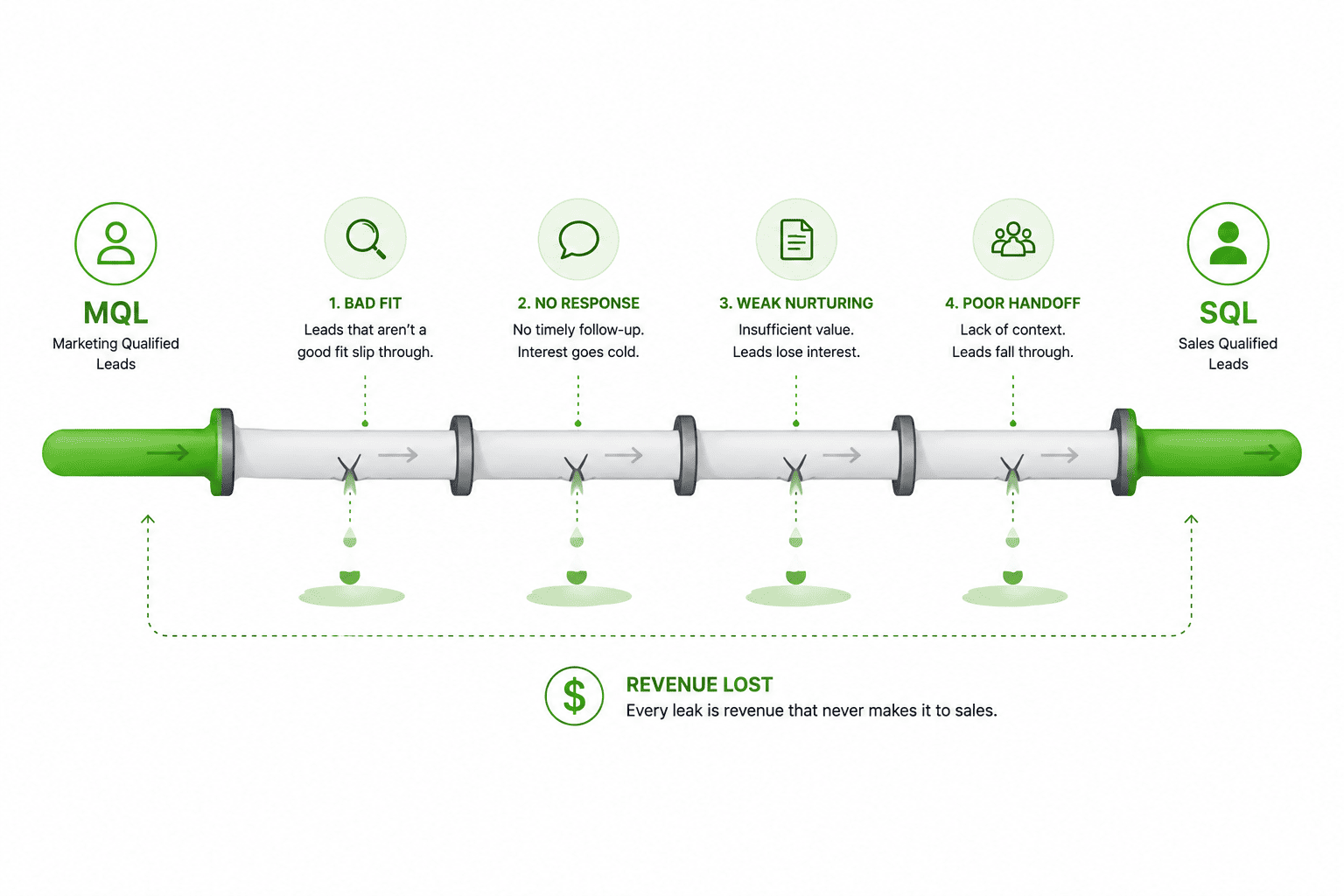
For B2B service firms, the distance between a Marketing Qualified Lead (MQL) and a Sales Qualified Lead (SQL) is one of the most expensive stretches of the revenue pipeline. It's where deals stall, where marketing investment loses momentum, and where pipeline progression slows down.
This gap is a definitional problem. When marketing and sales disagree on what makes a lead "qualified," revenue isn’t just leaking, it’s being lost in the gap between how leads are scored and how they are evaluated for sales readiness. If you don't know where your revenue dies between MQL and SQL, you are managing a funnel with a hidden failure point.
This piece explains why misaligned definitions disrupt pipeline progression, references research from Gartner and Highspot, and outlines a practical framework to fix the MQL-to-SQL handoff.
Marketing's definition of a qualified lead is typically based on engagement and fit. Sales defines qualification based on readiness to buy. When these definitions don’t align, the handoff becomes inconsistent.
Marketing teams prioritise leads that show intent through actions like content downloads, webinar attendance, and website engagement, along with alignment to an ideal customer profile.
Sales teams focus on leads that are ready for a commercial conversation. They prioritise clear indicators such as budget, authority, need, and timeline.
Insights from Highspot show that sales and marketing teams often disagree on what qualifies as a sales-ready lead. Without a shared definition, the sales process slows down, and the funnel becomes harder to manage.
The impact of this gap is measurable.
According to Gartner, 84% of business leaders identify the marketing-to-sales handoff as one of the most significant challenges in aligning their teams.
At the same time, 42% report that when marketing and sales are aligned, they connect with qualified leads faster. Shared definitions and clear qualification criteria reduce friction and help leads move more efficiently through the funnel.
A closer look at lead management shows where losses occur.
According to Highspot, when lead management is ineffective, pipelines stall, deal cycles extend, and sales teams spend time on prospects that are unlikely to convert.
In many cases, the issue isn’t a lack of leads, but a lack of agreement on which leads are worth pursuing.
When a lead that marketing considers qualified is rejected by sales, it creates:
Closing the definition gap requires moving from subjective judgment to shared criteria.
Both marketing and sales must agree on this checklist and use it consistently to determine when a lead moves forward.
Replace marketing-only scoring systems with a shared model that reflects both engagement data and sales validation criteria. This ensures leads are evaluated consistently before and after the handoff.
Every disqualified lead should return to marketing with a clear reason tied to the qualification criteria. This creates a feedback loop that improves targeting, messaging, and scoring over time.
Fixing the MQL-to-SQL gap requires structured analysis of how leads move through your funnel.
At alspark, we work with B2B and service businesses to analyse how leads transition from marketing to sales and identify where qualification logic breaks down.
Our Funnel Review examines:
The outcome is a clear view of where leads slow down or fail to progress during the transition from MQL to SQL.
Once the gaps are identified, the next step is implementing shared qualification criteria and clearer handoff systems.
The Funnel Review provides practical tools such as:
The goal is to replace inconsistent interpretation with a shared framework that both marketing and sales trust.
Most pipelines don’t fail because of a lack of leads. They fail because of how leads are qualified and handed off.
Marketing generates demand. Sales looks for readiness. But without a shared definition of what “qualified” means, it leads to slowing down, getting rejected, or never turning into real opportunities.
This gap is where pipeline efficiency breaks down. It’s where effort stops translating into outcomes.
The opportunity isn’t to increase activity. It’s to fix how qualification works across the funnel.
Ready to see where your MQL-to-SQL handoff is breaking down?
Book a Funnel Review with alspark. We’ll analyse how your current funnel defines and handles qualified leads, identify where leads slow down or fail to progress, and help you implement a shared qualification framework that makes your pipeline more consistent and reliable.