In most B2B service firms, growth is managed as a series of disconnected projects. You hire an agency for SEO. You hire a specialist for LinkedIn Ads. You have an internal team member "managing" the CRM. On the surface, this looks like a division of labour. In reality, it’s a recipe for revenue leakage.
When you treat SEO, Ads, and CRM as isolated silos, you create a "commercial gap." This is the space where data disappears, leads go cold, and revenue potential remains untapped. Fragmentation isn't just an operational annoyance; it's a silent killer of B2B growth.
According to research from Gartner, revenue operations helps reduce revenue leakage by aligning sales, marketing, and customer success into a unified system. By 2026, 75% of the highest-growth companies are expected to adopt a RevOps model.
For a mid-sized Australian consultancy or SaaS provider, that’s not just a rounding error, it’s the difference between scaling and stalling. This contrarian piece argues that the "project-based" mindset is obsolete. To win in the modern Australian B2B landscape, you must stop treating these functions as separate tasks and start managing them as a single, unified revenue system.
When your SEO team is focused on rankings, your Ads team is focused on clicks, and your sales team is focused on CRM activity, no one is focused on the end-to-end revenue cycle.
A significant portion of marketing-generated leads are never followed up on effectively, leading to wasted acquisition effort and missed revenue opportunities. Furthermore, misalignment across teams often results in slower sales cycles and higher acquisition costs, as processes become inefficient and disconnected.
For Australian B2B firms, these inefficiencies are compounded by a highly competitive market and a sophisticated buyer base. If your SEO efforts bring in a lead that your Ads retargeting ignores, or your CRM doesn't flag for immediate sales follow-up, you haven't just lost a lead, you've wasted the capital required to generate it.
Many businesses view SEO and Paid Ads as competing channels for the same budget. This is a fundamental misunderstanding of the B2B buying journey. In reality, they are two sides of the same coin.
Modern B2B buyers engage with multiple touchpoints across channels before making a decision. SEO provides the educational foundation, while Ads provide the strategic "nudge" to keep your brand top-of-mind. However, if these channels aren't integrated, you end up with "the SEO-Ads Paradox": you're paying twice for the same buyer without knowing which interaction actually drove the conversion.
Without a unified data strategy, you cannot achieve "GTM excellence." You are essentially flying blind, unable to see how organic search intent informs paid targeting, or how ad performance should dictate your content strategy. This disconnect creates a commercial gap that limits visibility into what actually drives revenue.
The CRM is often treated as a digital filing cabinet for the sales team. This is the most expensive mistake a B2B founder can make. Your CRM should be the "technological bridge" that connects every marketing interaction to a revenue outcome.
When SEO and Ads are disconnected from the CRM, the CRM becomes a black hole. Marketing sends leads over the wall, sales claims they are "low quality," and because the data isn't integrated, marketing has no way to prove otherwise or optimise their campaigns.
As Highspot highlights, disconnected workflows and siloed systems reduce visibility and efficiency across the revenue journey. When data, processes, and teams are not connected, organisations lose the ability to track performance across the full customer lifecycle.
A unified revenue system ensures that every ad click and every organic search visit is tracked directly into the CRM. This allows for:
● Closed-Loop Attribution: Knowing exactly which keyword or ad campaign resulted in a closed-won deal.
● Lead Scoring Alignment: Ensuring marketing and sales agree on what a "qualified" lead actually looks like.
● Automated Nurturing: Using CRM data to trigger specific ad sequences or email flows based on buyer behaviour.
To break the growth stalemate, you must adopt a Revenue Growth Framework that prioritises the customer journey over departmental thinking. This is the core of Revenue Operations (RevOps).
RevOps is a structural shift: it moves the responsibility for revenue from individual departments to a unified function that manages four core pillars:
● People: Clear ownership of each handoff between marketing, sales, and customer success.
● Processes: Repeatable steps that move a lead from first click to closed deal.
● Data: One source of truth every team pulls from, instead of siloed dashboards.
● Technology: CRM and ad platforms wired together, not managed as separate tools.
This model integrates teams and systems to create a single source of truth across the entire revenue lifecycle.
In the Australian market, where service businesses rely heavily on reputation and long-term relationships, this level of alignment is a significant competitive advantage. It ensures a consistent customer experience from the first Google search to the final contract signature.
At alspark, we don't do "SEO projects" or "Ads management." We build B2B revenue systems. We understand that your SEO strategy is only as good as your CRM's ability to track its impact, and your Ads are only effective if they are integrated into a broader sales enablement workflow.
Our approach is built on three non-negotiable principles:
Stop looking for the next "growth hack" and start looking at your architecture. If your SEO, Ads, and CRM are separate projects, you don't have a growth strategy; you have a collection of expensive hobbies.
Your growth isn’t broken, it’s just disconnected. That disconnection is expensive: every SEO win Ads doesn’t build on, every lead the CRM doesn’t act on fast enough, is revenue you already paid to generate and then let go cold.
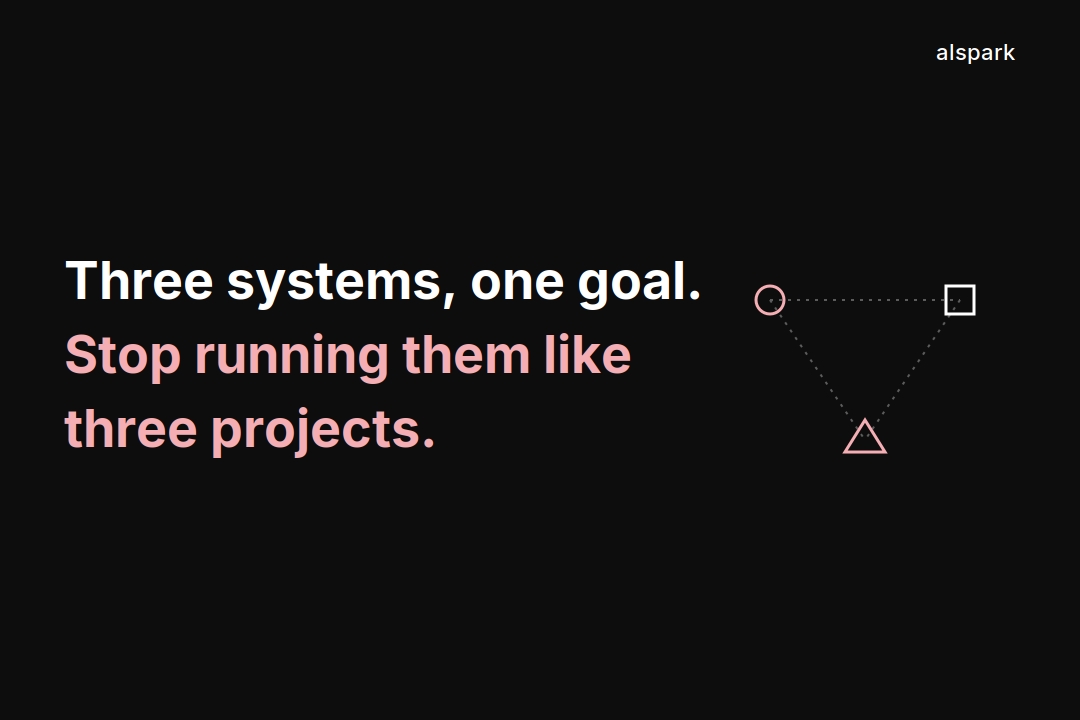
Fixing it isn’t about hiring a better agency for any single function, it’s about treating SEO, Ads, and CRM as one system with one owner, not three projects running in parallel.
Book a Revenue Systems Audit with alspark. We’ll review how your SEO, Ads, and CRM currently connect, identify where leads and data are being lost, and show you what a unified revenue system should look like in your business.
A commercial gap is the space between your SEO, Ads, and CRM where data disappears and no one owns the handoff. It shows up as leads that never get flagged for sales follow-up, ad spend that ignores organic intent signals, and pipeline reports that can't trace a closed deal back to its original channel.
A few warning signs point to disconnected systems:
● Marketing and sales disagree on what counts as a qualified lead
● Your CRM has no record of which keyword or ad campaign produced a closed deal
● SEO and Ads teams report on clicks and rankings instead of revenue
● Retargeting ads keep chasing leads your CRM has already marked as sales-ready
Yes, largely. RevOps is the structural fix for this exact kind of fragmentation. It unifies the people, processes, data, and technology across marketing, sales, and customer success into one system, rather than leaving each function to manage its own project.
Usually process first, software second. Most CRMs and ad platforms already support the integrations required. What's typically missing is a shared definition of a qualified lead and a rule that every ad click and organic visit gets logged against the same customer record.
It depends on how disconnected your current stack is, but most B2B service firms can get a working closed-loop attribution setup in place within a focused engagement of a few weeks, not months. Getting SEO, Ads, and CRM owners to agree on shared definitions is usually the longer piece.
1. Gartner. Revenue Operations: The What, Best Practices & RevOps Guide.
https://www.gartner.com/en/sales/topics/revenue-operations
2. Highspot. The RevOps Frameworks That Drive Growth and Alignment.