For Australian B2B service firms, SEO has become a non‑negotiable investment. You pour budget into content, technical optimisation, and link building, and you watch your traffic numbers climb. But if that traffic isn't systematically qualified and handed off to sales, you aren't building a revenue engine; you're renting a leaky bucket.
Demand without qualification is just an expense. When SEO‑driven visitors hit your site but never become qualified leads, you are paying for clicks that vanish into the digital ether. The core issue isn't your SEO strategy; it's the missing bridge between your traffic and your CRM. Without CRM discipline, your SEO investment is a cost centre, not a growth lever.
This piece explains why the traffic‑to‑revenue gap exists, how a lack of CRM discipline turns SEO into a leaky bucket, and provides a concrete framework to align your organic efforts with your commercial pipeline.
Most B2B leaders track SEO success through top‑of‑funnel metrics: organic traffic, keyword rankings, and page‑view growth. These are important, but they are only half the story. The real metric that matters is revenue per organic visitor, a number most businesses cannot calculate.
When you focus solely on traffic volume, you optimise for the wrong outcome. You celebrate a 30% increase in visitors while ignoring that your lead‑to‑opportunity conversion rate has dropped by 40%. This is the traffic‑to‑revenue gap: a widening chasm between what you measure and what actually pays the bills.
High traffic numbers create a false sense of security. They make marketing reports look healthy and justify ongoing SEO spend. However, as Gartner research reveals, 74% of B2B buyer teams experience unhealthy conflict during the decision process. This means that even if your traffic is reaching the right companies, internal misalignment within those companies can stall deals long before they reach your CRM.
If your SEO is driving visitors but your CRM isn't capturing and qualifying those visitors in a way that sales trusts, you are feeding a dysfunctional buying journey.
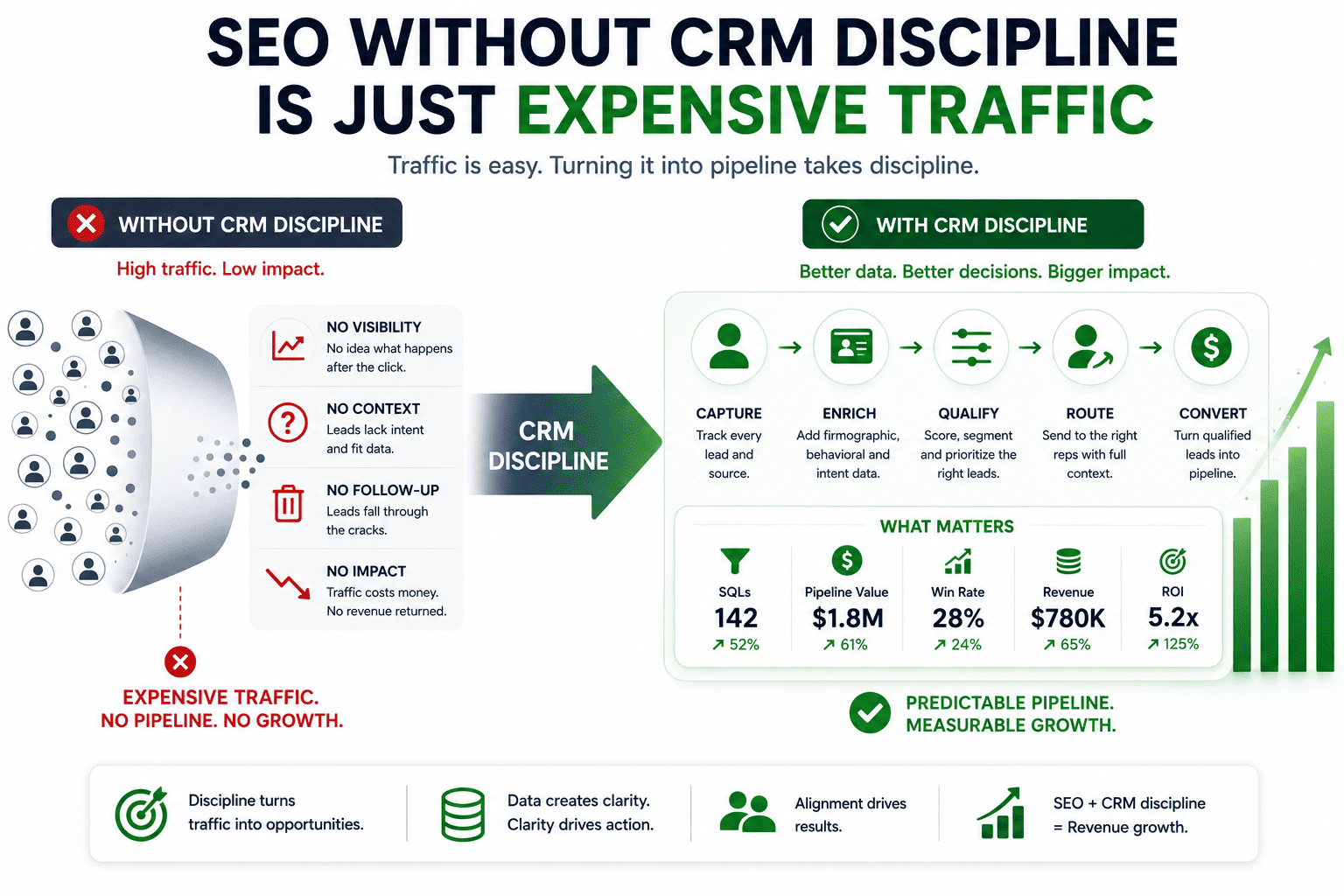
Imagine filling a bucket with a steady stream of water (SEO traffic) while that bucket has multiple holes (lack of CRM discipline). No matter how much water you pour in, the bucket never fills. The same principle applies to your revenue pipeline.
The "holes" in your bucket are the points where unqualified traffic escapes:
Each of these holes represents a direct revenue leak. According to research cited by Whitehat SEO, companies with aligned sales and marketing teams achieve 103% higher goal attainment and 38% higher sales win rates. Alignment starts with CRM discipline.
To transform SEO from an expense into an engine, you need to embed three core disciplines into your CRM.
Not all SEO traffic is created equal. A visitor who reads a pricing page is showing a different intent than one who downloads a generic ebook. Your CRM must automatically score leads based on their behaviour, demographics, and engagement level.
Effective lead scoring turns raw traffic into a prioritised sales queue. It ensures that sales focuses on the prospects most likely to buy, while marketing nurtures those who aren't yet ready.
An SLA is a written agreement that defines what constitutes a "qualified lead," how quickly sales will follow up, and what feedback marketing will receive. This eliminates the trust deficit that kills pipeline velocity.
As the Whitehat SEO article outlines, aligning teams requires "establishing shared goals, creating formal Service Level Agreements (SLAs) that define lead quality and handoff protocols, fostering leadership buy‑in, implementing consistent communication rhythms, and deploying sales enablement content."
Your CRM must be configured to track the entire customer journey from first organic click to closed‑won deal. This allows you to calculate metrics like:
With this data, you can stop guessing which SEO efforts work and start doubling down on what actually drives revenue.
The benefits of bridging the SEO‑CRM gap extend far beyond lead volume. When your organic traffic is seamlessly qualified and handed off, you unlock a predictable, scalable growth engine.
SEO is not a traffic game; it's a revenue game. If you're driving clicks without CRM discipline, you are simply buying expensive attention that never translates into bankable deals. The fix isn't more content or more keywords, it's building the bridge between your traffic and your CRM.
Is your SEO investment leaking revenue?
Book a Growth Audit today. At alspark, we specialise in turning SEO traffic into a qualified pipeline by implementing the CRM discipline frameworks that Australian B2B firms need to scale.

.png)
.png)
.png)