For Australian B2B service firms, SEO is often treated as a traffic channel, something that lives in marketing, measured by rankings and clicks, and celebrated when visitor numbers climb.
Yet, if your SEO isn't integrated with your Revenue Operations (RevOps) framework, you aren't building a predictable pipeline; you're renting attention that may never convert.
SEO must operate inside a growth system. When organic traffic flows into a siloed marketing function, it becomes a cost centre. When that same traffic feeds a unified RevOps engine where marketing, sales, and operations share data, goals, and metrics, it becomes a predictable pipeline machine.
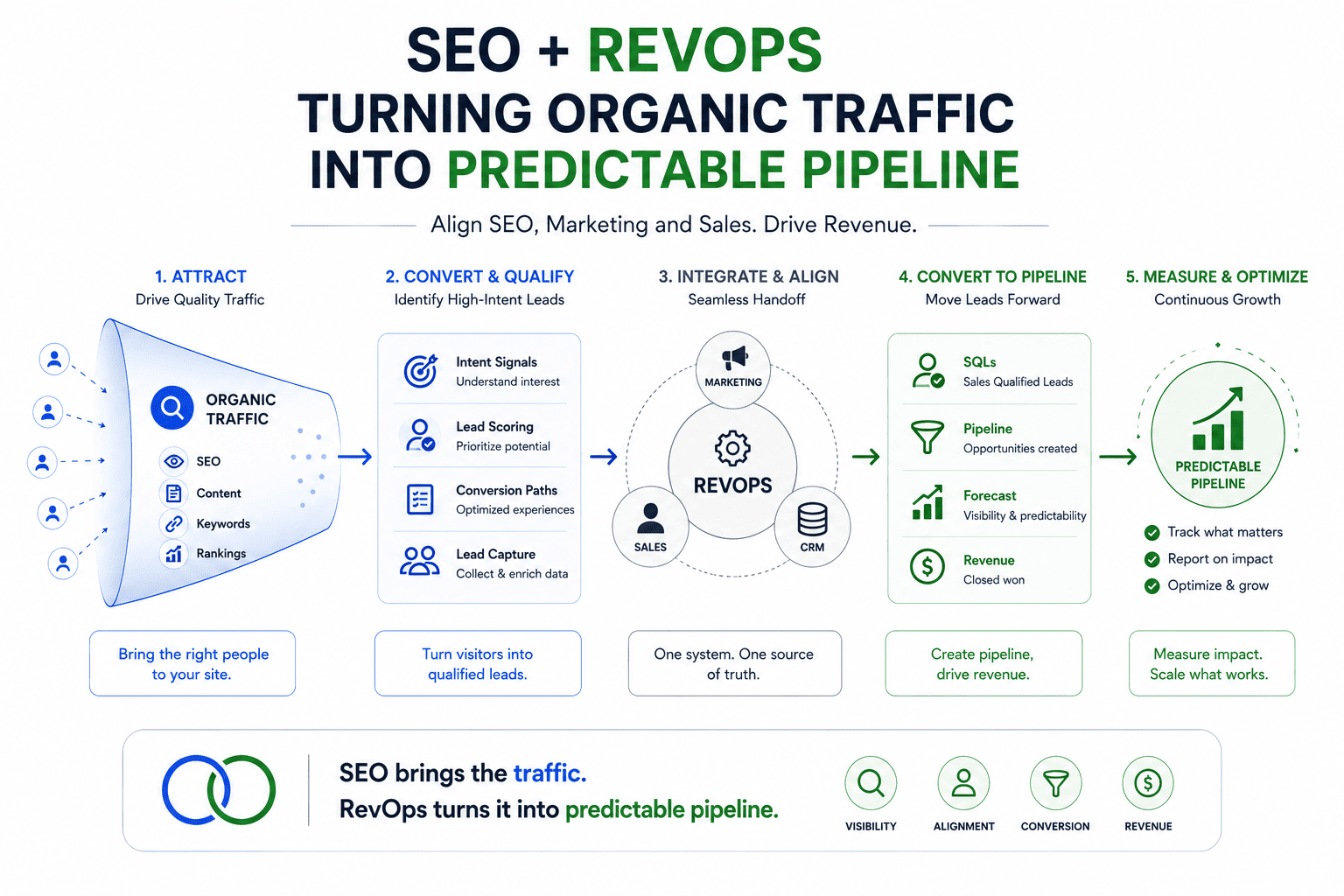
This piece explains the SEO‑RevOps gap, introduces the three pillars that turn organic traffic into a predictable pipeline, and provides a concrete framework to align your SEO efforts with your revenue operations.
In most B2B organisations, SEO reports to marketing. Its success is measured by marketing metrics: organic traffic, keyword rankings, and lead volume. These numbers are valuable, but they tell only half the story. The missing half is revenue: how much pipeline did that traffic generate, at what cost, and with what velocity?
The gap exists because SEO and RevOps speak different languages. SEO talks about intent and visibility. RevOps talks about pipeline velocity, cost per SQL, and revenue attribution. Without a bridge between them, organic traffic becomes an isolated input rather than an integrated growth lever.
According to Martal Group, misaligned sales and marketing teams lose up to $1 trillion annually in wasted spend and inefficiencies.
Nearly 80% of marketing leads go unconverted due to a lack of coordination. When SEO drives traffic that marketing can't qualify and sales can't trust, you are literally pouring budget into a leaky bucket.
Turning organic traffic into a predictable pipeline requires three deliberate pillars: alignment, attribution, and automation.
Alignment means that SEO, marketing, sales, and operations share the same goals, metrics, and definitions. It's not about collaboration; it's about integration.
Action: Create a joint revenue plan that defines:
As Directive Consulting notes, a modern B2B go‑to‑market strategy is “the operating system that drives demand, conversion, and predictable revenue.” That operating system starts with alignment.
Attribution is the technical backbone that traces organic visits through the entire revenue funnel. Without it, you cannot measure SEO's true ROI.
Action: Implement a closed‑loop attribution system that:
When you can trace a closed‑won deal back to the exact keyword that started the journey, you stop guessing which SEO efforts work and start scaling what actually drives revenue.
Automation ensures that high‑intent organic leads are instantly scored, routed, and followed up on without manual intervention.
Action: Deploy an automated lead‑management engine that:
Automation bridges the gap between SEO's volume and sales' capacity, ensuring that no high‑intent lead falls through the cracks.
Implementing the three pillars doesn't require a complete overhaul. Start with these four steps:
According to Gartner, 75% of the highest-growth companies will deploy a RevOps model by 2025. The companies that integrate SEO into their RevOps framework will have a decisive advantage: they will know exactly which organic efforts drive pipeline, and they will be able to scale those efforts with confidence.
If your SEO is still measured by rankings and traffic, you are missing the revenue potential of your organic investment. The shift from SEO‑as‑a‑channel to SEO‑as‑a‑growth‑lever requires a RevOps mindset and a concrete plan to align, attribute, and automate.
Book a Strategy Call today. At alspark, we specialise in building SEO‑RevOps engines that turn organic traffic into a predictable pipeline for Australian B2B firms. We'll help you audit your current state, define the right metrics, and implement the technical foundations that scale.


.png)
.png)
.png)