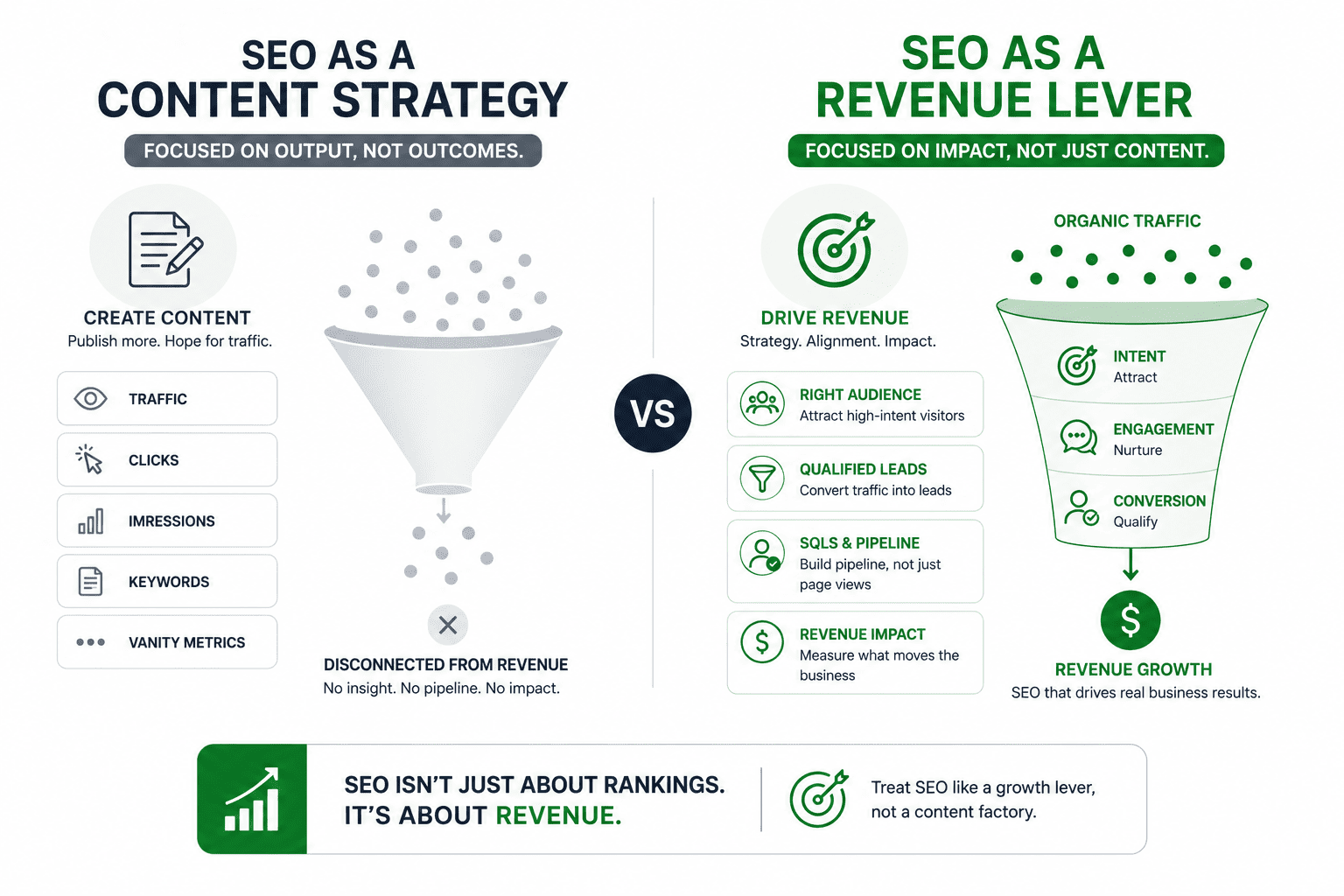
For most B2B organisations, SEO is tucked away in the 'content marketing' bucket. It’s seen as a long-term play for brand awareness, measured by traffic volume and keyword rankings. But in a high-stakes B2B environment, this framing is a strategic error.
When SEO is treated as a content strategy, it remains a cost centre. When it is reframed as a revenue lever, it becomes a core business function that drives predictable growth.
The shift is more than semantic. It’s about moving from 'visibility' to 'velocity.' Research cited by Brixon Group, referencing Gartner data, suggests companies with poor marketing–sales alignment may lose 10–15% of potential revenue. Reframing SEO as a revenue lever is the first step in closing that gap.
This insight piece explores why the 'content strategy' label limits your growth, how to view SEO through a Chief Revenue Officer (CRO) lens, and the tactical shifts required to turn organic search into a high-performance revenue engine.
Marketing teams often fall into the trap of chasing traffic for traffic's sake. They produce high volumes of top-of-funnel content to satisfy ranking algorithms, but if that traffic doesn't convert into pipeline, it’s a vanity exercise.
As Gartner reports, CMO budgets have flatlined at approximately 7.7% of overall company revenue. In an era of stagnant budgets, every marketing dollar must be defensive and productive.
Treating SEO as a 'content strategy' often leads to bloated content calendars that lack commercial intent, wasting precious resources on visitors who will never buy.
A Chief Revenue Officer doesn't care about 'Domain Authority' or 'Search Volume.' They care about Customer Acquisition Cost (CAC), Pipeline Velocity, and Lifetime Value (LTV). When you frame SEO as a revenue lever, you start asking different questions:
To move beyond the content strategy mindset, B2B leaders must implement three fundamental shifts in how they manage and measure organic search.
Stop reporting on total organic sessions. Instead, report on Organic Pipeline Contribution. This requires a technical bridge between your SEO data and your CRM. You need to know not just that someone clicked, but that the click eventually turned into a Sales Qualified Lead (SQL).
A content strategy focuses on publishing. A revenue lever focuses on converting. This aligns SEO with Conversion Rate Optimisation (CRO). Every high-ranking page should be treated as a landing page, with clear, revenue-aligned calls to action (CTAs) that move the prospect closer to a commercial conversation.
SEO cannot live in a vacuum. It must be integrated into your Revenue Operations (RevOps) framework. This means SEO signals (search intent) should inform sales qualification, and sales feedback (lead quality) should inform SEO keyword targeting. Alignment isn't just a 'nice to have'. HubSpot reports that 87% of sales and marketing leaders say collaboration between the two teams drives critical business growth.
The search landscape is changing. Gartner predicts that traditional search engine volume will drop 25% by 2026 due to the rise of AI chatbots and virtual agents.
In a world with less search volume, the traffic you do get must be higher quality and more effectively converted. You can no longer afford to 'spray and pray' with content. You must be surgical.
Framing SEO as a revenue lever ensures that your remaining search visibility is focused entirely on the queries that drive business outcomes.
If you want SEO to be taken seriously at the executive level, stop talking about content. Start talking about revenue. Frame your organic strategy as a tactical lever to lower CAC, increase pipeline predictability, and drive commercial growth.
The 'content strategy' era of SEO is over. The 'revenue lever' era has begun.
Is your SEO strategy aligned with your revenue goals?
Book Your Strategy Call Now. At alspark, we help Australian B2B firms transform SEO into a predictable revenue engine by engaging decision-makers and strengthening pipeline visibility.


.png)
.png)
.png)