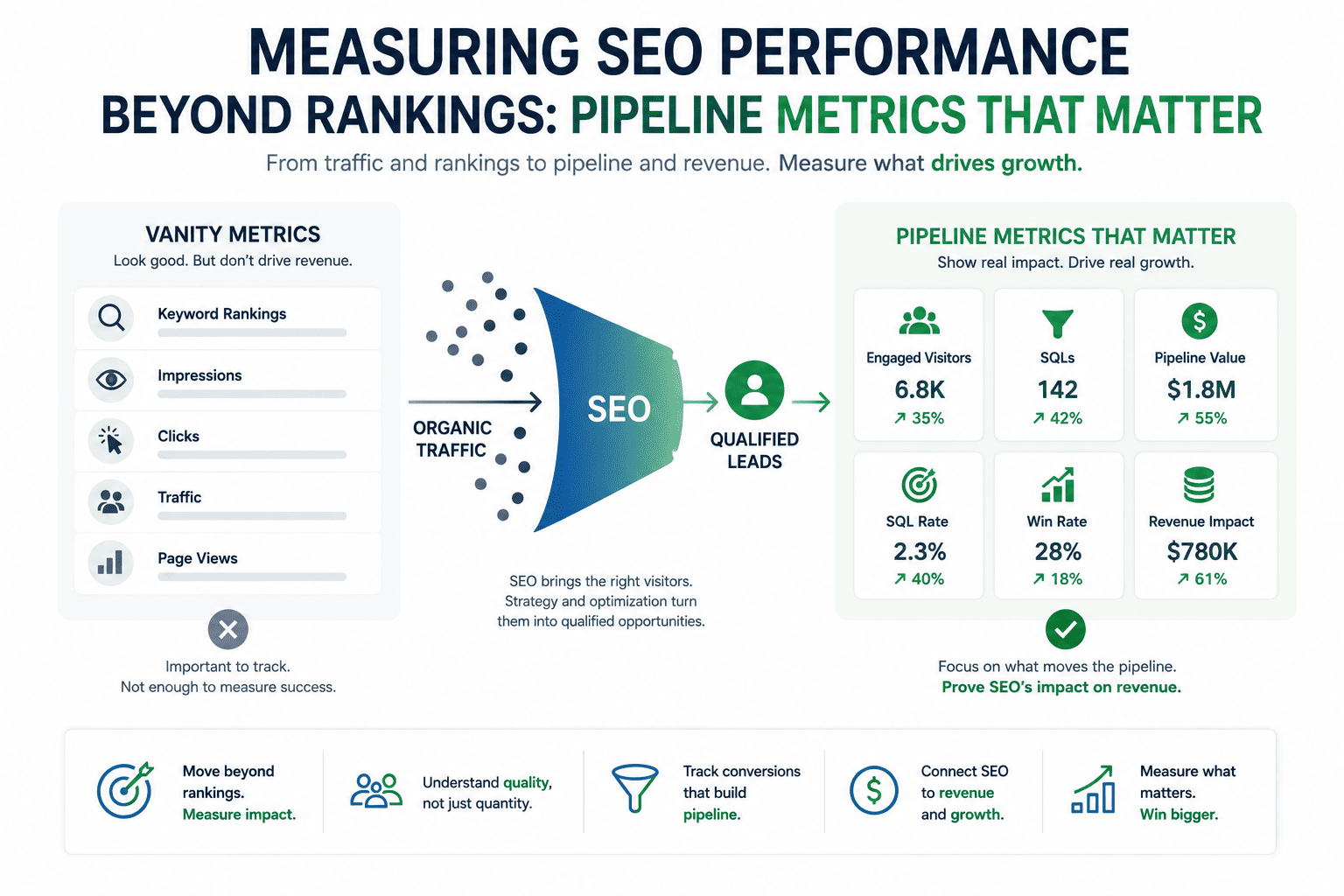
For Australian B2B service firms, SEO has become a default investment. You track keyword rankings, celebrate moving from #8 to #3, and report organic traffic growth to your board. Yet, if you're not measuring SEO's impact on pipeline and revenue, you are optimising for vanity, not value.
Rankings don't equal revenue. In fact, a #1 ranking for a low‑intent keyword can generate zero pipeline, while a #5 ranking for a high‑intent commercial term can drive millions in closed‑won deals. The difference is the metric you're tracking. When you shift from ranking‑based reporting to pipeline‑based measurement, you transform SEO from a cost centre into a predictable revenue lever.
This piece explains why rankings are a vanity metric, introduces the three pipeline metrics that actually matter for B2B revenue, and provides a concrete framework to build a revenue‑attribution engine that shows the true ROI of your SEO investment.
Keyword rankings are a measure of visibility, not commercial impact. They tell you where you appear in search results, but nothing about whether those appearances lead to qualified leads, sales conversations, or closed deals.
According to Whitehat SEO, the B2B SEO playbook from two years ago is “no longer fit for purpose.” Google now processes over 14 billion searches daily, yet organic click‑through rates are falling as AI‑powered search grows.
Businesses that adapt will gain a first‑mover advantage; those stuck measuring rankings will continue to invest in visibility that doesn't convert.
The fundamental problem is that rankings measure an intermediate step, not an outcome. You can rank #1 for “what is CRM” and attract thousands of visitors who are early in their research journey, visitors who may never become customers.
Meanwhile, you might rank #7 for “CRM pricing for Australian SaaS” and attract a handful of visitors who are ready to buy. Which ranking actually matters for revenue?
To measure SEO's true impact, you must track metrics that connect directly to the pipeline and revenue. These three metrics shift the conversation from “how many visitors?” to “how much pipeline?”
This is the ultimate measure of SEO efficiency. It answers the question: “For every visitor who arrives via organic search, how much revenue do they generate?”
Calculation: (Total revenue attributed to organic search) ÷ (Total organic visitors) over a defined period.
Why it matters: It collapses the entire funnel into one number. If your revenue per organic visitor is increasing, your SEO is driving higher‑quality traffic and/or converting that traffic more effectively. If it's stagnant or falling, you're attracting visitors who aren't buying.
This metric measures the efficiency of your SEO investment in generating leads that sales actually want to talk to.
Calculation: (Total SEO investment) ÷ (Number of SQLs attributed to organic).
Why it matters: It allows you to compare SEO's cost‑per‑lead against other channels (paid search, outbound, events). If your organic cost per SQL is significantly lower than your paid channels, you have a sustainable growth engine. If it's higher, you need to revisit your keyword targeting or qualification process.
This metric tracks how effectively you turn organic visitors into live pipeline opportunities.
Calculation: (Number of opportunities created from organic) ÷ (Total organic visitors).
Why it matters: It exposes leaks in your middle funnel. A low conversion rate indicates that your SEO traffic isn't aligned with your Ideal Customer Profile, or that your website isn't effectively nurturing visitors toward a sales conversation.
Tracking these pipeline metrics requires a deliberate attribution setup. You can't rely on last‑click attribution or default Google Analytics reports. You need a closed‑loop system that connects organic visits to CRM opportunities.
Tag every internal link, content offer, and campaign with UTM parameters that capture the source, medium, campaign, and keyword. This allows you to trace which specific SEO efforts drive the pipeline.
Your CRM must receive UTM data and associate it with lead and opportunity records. Platforms like HubSpot, Salesforce, and Marketo offer native integrations; if you're using a custom stack, you'll need to build API connections.
Create a dashboard that shows, at a minimum:
Review this dashboard weekly with your marketing and sales leaders. Use it to make decisions about where to invest your SEO budget.
Shifting from rankings to pipeline metrics doesn't happen overnight. To help you get started, we've created a step‑by‑step diagnostic checklist that walks you through:


.png)
.png)
.png)