For Australian B2B service firms, SEO reporting has become a ritual of self‑deception. You track keyword rankings, celebrate organic traffic growth, and present beautiful dashboards filled with green arrows.
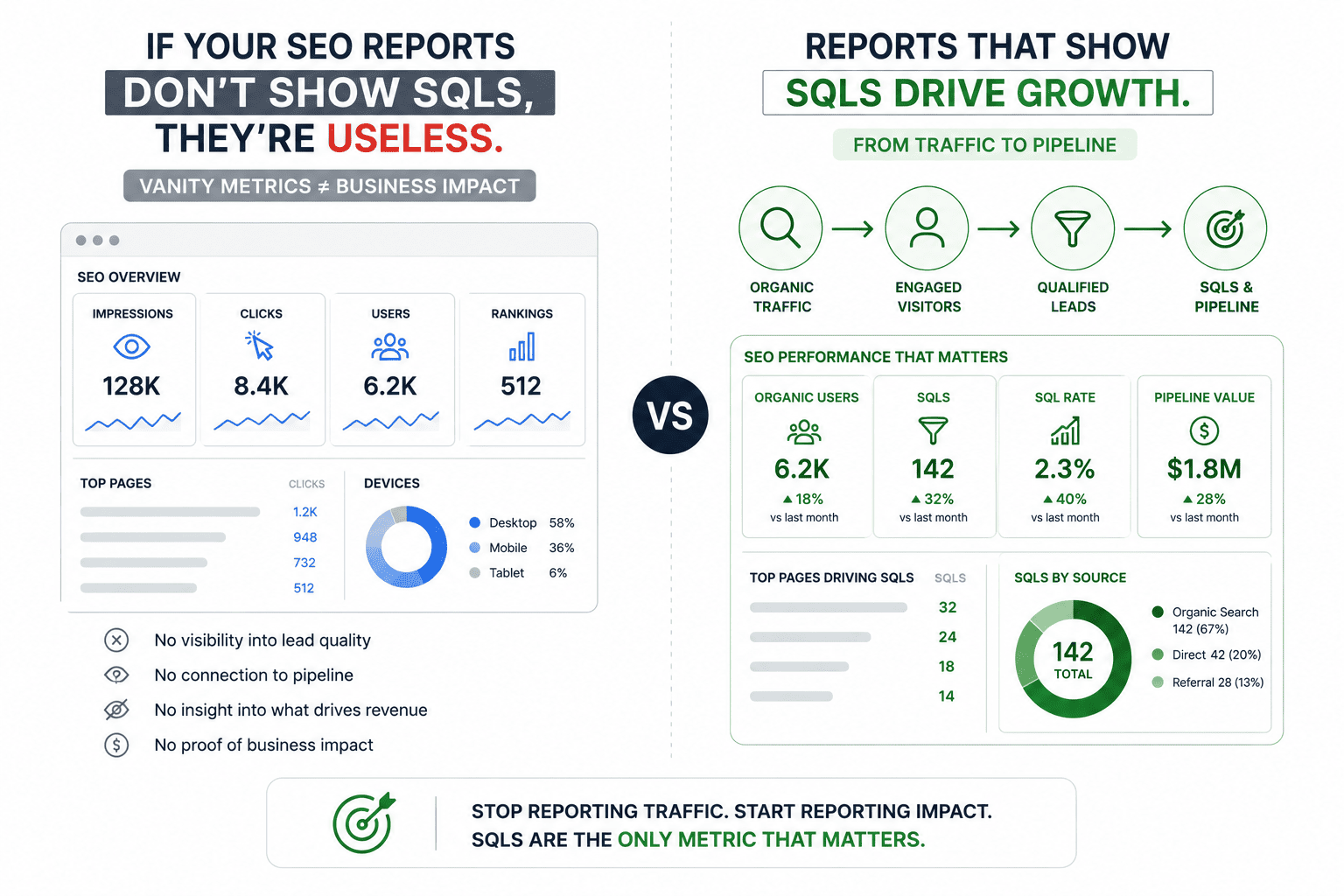
But if those dashboards don’t show Sales Qualified Leads (SQLs), they are not just incomplete, they are actively misleading.
Traffic reporting is not revenue reporting. When you measure SEO success by visits and rankings, you are optimising for vanity, not value.
According to Brixon Group, the conversion rate from Marketing Qualified Leads (MQLs) to Sales Qualified Leads (SQLs) is a critical business success indicator for B2B growth. If your SEO reports don’t show SQLs, you are managing a cost centre, not a revenue engine.
This contrarian piece explains why traffic‑focused SEO reporting is a vanity‑metric trap, why SQLs are the only metric that matters for revenue, and provides a concrete framework to turn your SEO reporting into a revenue‑attribution tool.
Most B2B leaders track SEO performance through top‑of‑funnel metrics: organic traffic, keyword rankings, and page‑view growth. These numbers are easy to measure, easy to visualise, and easy to celebrate. They are also dangerously incomplete.
A #1 ranking for a low‑intent keyword can generate thousands of visits and zero pipeline. A #5 ranking for a high‑intent commercial term can drive millions in closed‑won deals. When you focus on visibility alone, you miss the commercial signal hidden in the noise.
Research cited by Martal Group, referencing MarketingSherpa, shows that only 27% of marketing-generated leads passed to sales are actually qualified.
SEO teams often report “success” when traffic grows by 20% month‑over‑month. Sales teams report “failure” when pipeline coverage drops below 2x. These two perspectives aren’t contradictory, they are measuring different outcomes. The gap between them is where revenue dies.
When your SEO reports don’t connect to SQLs, you create a reporting‑reality gap that misaligns marketing investment with commercial outcomes. You pour budget into content that attracts visitors, not buyers.
For B2B revenue leaders, a Sales Qualified Lead (SQL) is the first reliable signal of commercial intent. It’s the point where a prospect has been validated by sales as having a genuine need, budget, and timeline. Every metric before that is guesswork.
According to Brixon Group, the conversion rate from MQLs to SQLs is not just a marketing KPI, it is a critical business‑success indicator. In long B2B buying cycles, revenue teams also monitor how efficiently leads progress through qualification stages, since leads that stall in the pipeline often fail to convert into real opportunities.
Improving your SQL rate by just 10 percentage points (for example, from 10% to 20%) can potentially double your pipeline, even without increasing traffic or ad spend. That’s why SQLs, not sessions, should be the north‑star metric of your SEO program.
Modern lead‑qualification stages MQL, SQL, PQL are powered by intent data and digital behaviour. As Martal Group notes, defining clear qualification stages creates a common language for when a lead is ready for sales.
If your SEO reports don’t map organic visitors to these stages, you are leaving revenue on the table. A visitor who downloads a pricing page is signalling commercial intent; a visitor who reads a top‑of‑funnel blog post is signalling awareness. Treating them the same in your reporting is a revenue leak.
Turning your SEO reports from vanity dashboards into revenue tools requires three deliberate shifts.
Replace “organic traffic” with “revenue per organic visitor.” Replace “keyword rankings” with “SQLs generated by keyword.” Build a simple attribution model that connects organic visits to SQLs and closed‑won deals.
Use UTM parameters, CRM integration, and lead‑scoring rules to tag organic traffic with commercial intent. If a keyword consistently drives SQLs, double down on it. If it drives only top‑of‑funnel traffic, deprioritise it.
Your CRM should know which leads came from organic search, which pages they visited, and how far they progressed in the qualification journey. According to Gartner, integrating marketing‑source data with sales pipelines is a hallmark of high‑performing B2B revenue teams.
When sales can see the SEO journey of a lead, they can prioritise follow‑up, tailor conversations, and accelerate conversion. Without that integration, SEO is just expensive traffic.
Change what you celebrate. Present monthly SEO reports that start with SQLs generated, pipeline influenced, and revenue attributed. Show the cost per SQL from organic search versus other channels. Highlight which content assets are driving qualification, not just clicks.
This shift forces your SEO strategy to align with commercial outcomes. It turns SEO from a content function into a revenue function.
Building a revenue‑attribution engine for SEO doesn’t require a six‑figure martech stack. It requires discipline and three simple components.
When you connect SEO signals to SQLs, you stop guessing and start scaling. You know exactly which organic investments are driving the pipeline, and you can reallocate the budget accordingly.
If your SEO reports don’t show SQLs, they are useless. They are measuring activity, not outcomes. They are celebrating traffic, not the pipeline. They are keeping SEO a cost centre instead of turning it into a predictable revenue lever.
For Australian B2B service firms, the choice is clear: continue reporting vanity metrics and watch your SEO budget evaporate into unqualified traffic, or refocus your reporting on SQLs and turn organic search into a bankable growth channel.
The shift starts with a single question at your next growth review: “How many SQLs did our SEO drive last month?” If you can’t answer that, you don’t have an SEO report, you have a distraction.
Ready to turn your SEO reporting into a revenue tool?
At alspark, we’ll analyse your current SEO‑to‑SQL conversion, identify the leaks in your attribution model, and build a reporting framework that shows you the pipeline, not just the page views.


.png)
.png)
.png)